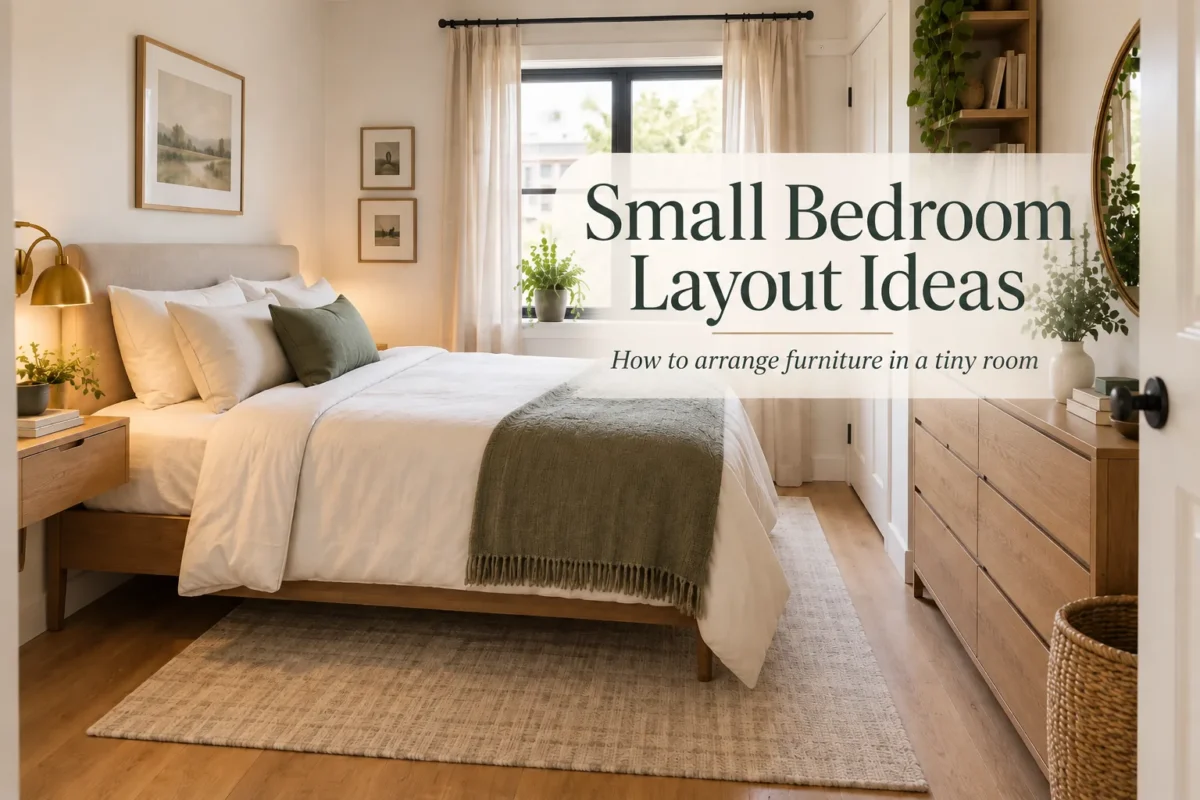
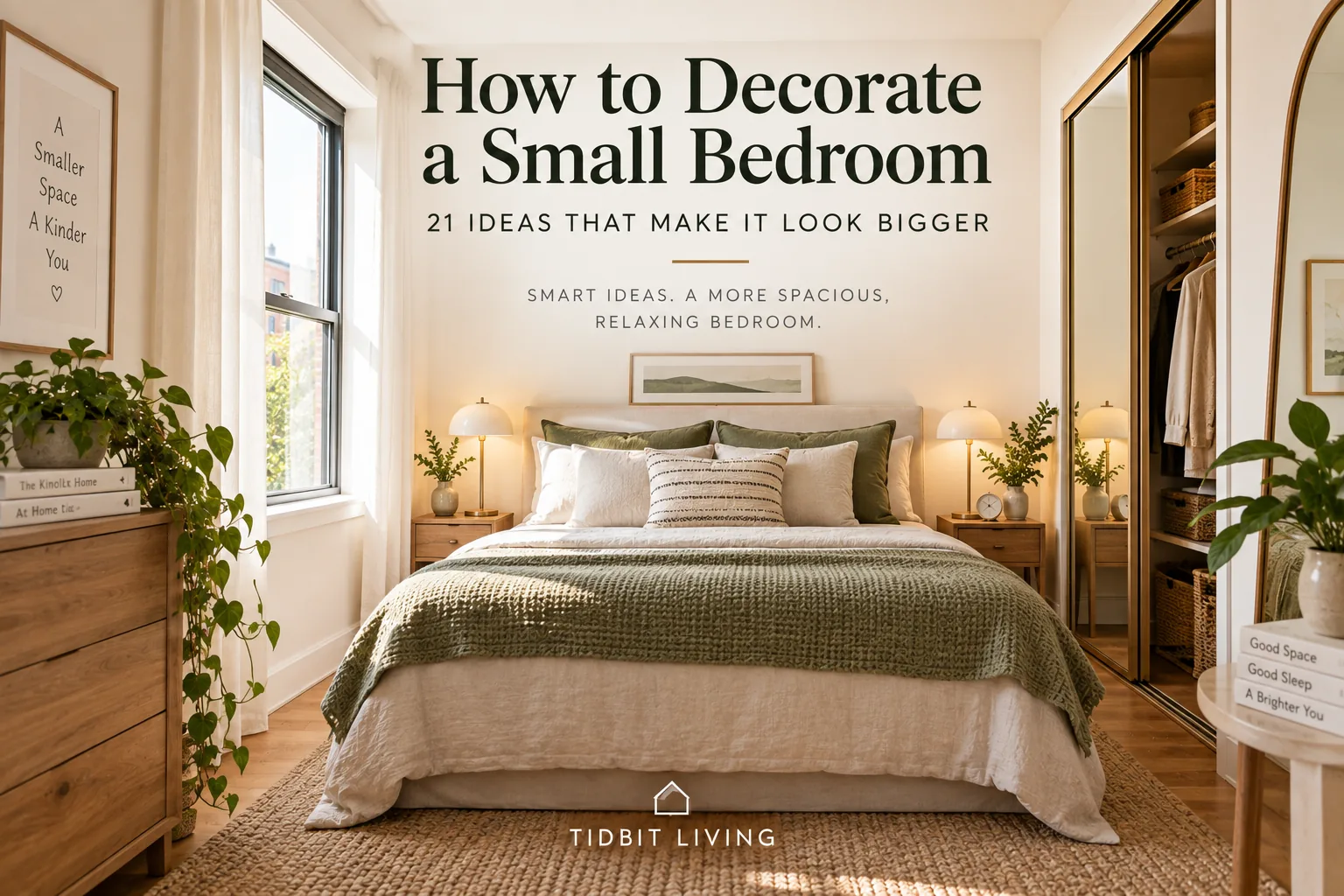

Decorating a small bedroom is not about making every piece of furniture tiny or painting everything white. The real goal is to make the room feel calm, easy to move through, and visually open while still giving you enough storage, lighting, and personality to enjoy being there.
This guide focuses specifically on small bedrooms, not small apartments in general. If the whole home is compact, see our small apartment decorating ideas. If you are choosing furniture for the entire apartment, use our small-apartment furniture guide.
Before You Decorate: Solve the Bed and Walking Path First
The bed usually controls the entire room because it is the largest object and the one piece you cannot easily ignore. Before buying decor, decide where the bed goes and whether you can comfortably reach the door, closet, drawers, and window.
In many small bedrooms, the longest uninterrupted wall is the easiest place to start. But a centered bed is not automatically best. If centering it leaves two useless slivers of space, pushing the bed toward one wall may create a functional bedside zone on the other side.
| If your room has this problem | Try this first | Usually avoid |
|---|---|---|
| Bed blocks the main route | Move it to the longest clear wall or reduce side furniture | Adding more storage before fixing circulation |
| No room for two nightstands | Use one nightstand plus a wall shelf or sconce | Forcing symmetry that makes the room harder to use |
| Closet doors cannot open fully | Reduce bed width or shift bed position | Ignoring door swing because the furniture technically “fits” |
| Room feels crowded from the doorway | Lower the visual weight near the entry | Tall bulky furniture on the first sightline |
| Bedroom is dark | Protect the window and add layered lighting | Blocking the window with tall storage |
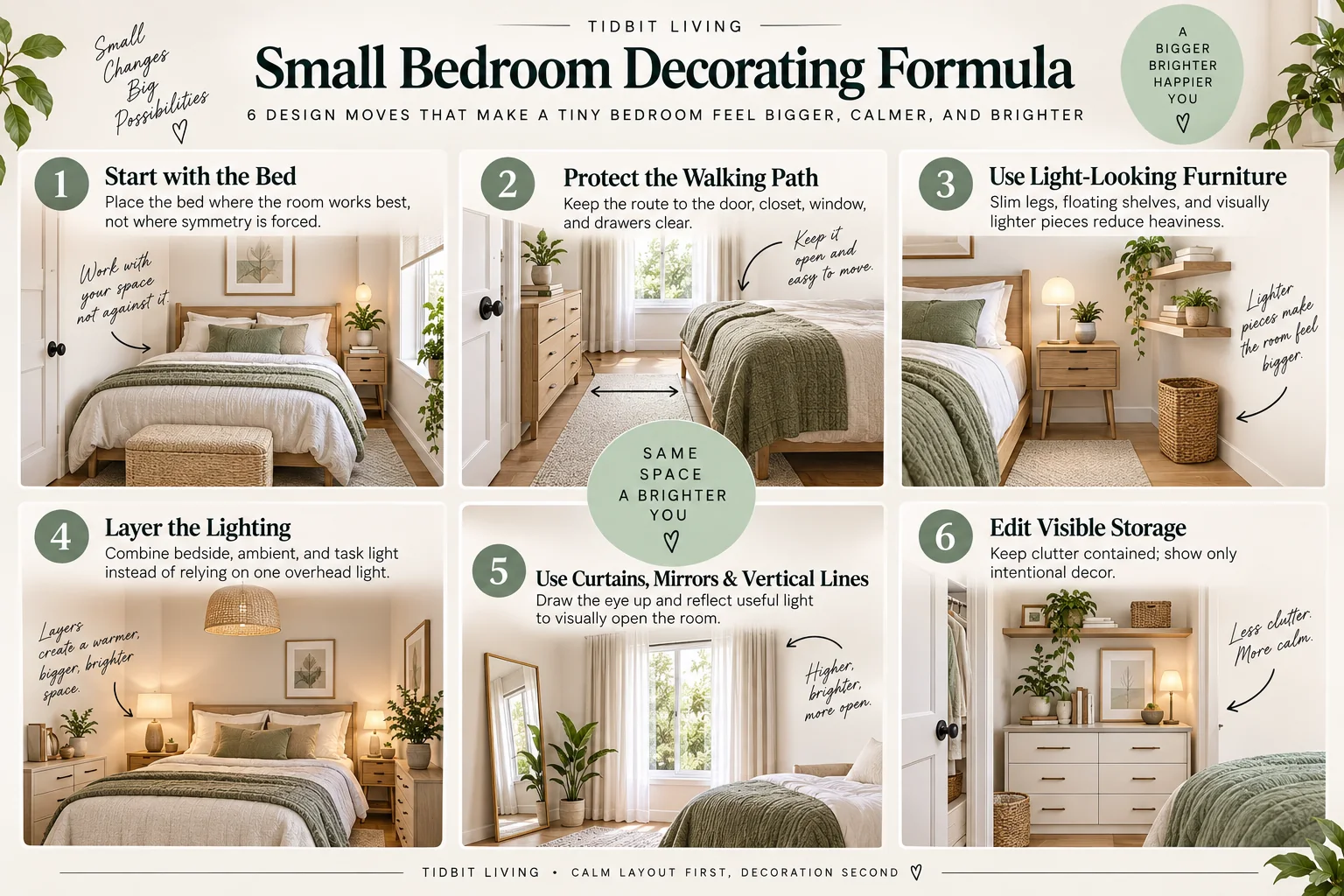
1. Bed placement → 2. Walking route → 3. Storage → 4. Lighting → 5. Textiles → 6. Wall decor.
If you reverse that order, you can end up decorating around a layout that never worked.
21 Small Bedroom Decorating Ideas
1. Put the Bed Where the Room Works Best, Not Where It Looks Most Symmetrical
Symmetry is attractive, but in a very small bedroom it can waste usable space. If centering the bed leaves narrow gaps on both sides that cannot hold anything useful, move the bed off-center and create one functional bedside zone instead.
For example, a 9-foot-wide bedroom with a queen bed may work better with one proper nightstand and one wall-mounted shelf than two undersized tables squeezed into both sides.
2. Keep the First Sightline Calm
Stand in the doorway and notice what you see first. If the first view is a pile of clothes, an overflowing open shelf, or the side of a tall wardrobe, the room will feel tighter than it is.
Give the entrance one calm focal point: a made bed, a piece of art, a headboard, or a visually quiet dresser. Try to keep the route into the room obvious.
3. Choose a Bed Frame With Less Visual Bulk
A bed can occupy the same floor area but feel much lighter depending on the frame. Slim legs, a simple platform, an open base, or a modest upholstered headboard usually creates less visual mass than a thick sleigh bed, oversized footboard, or chunky storage frame.
This does not mean the bed must be low. In fact, seeing more floor under the bed can make a small room feel more open because the eye reads more continuous floor area.
4. Use Under-Bed Storage Only for Things You Actually Need to Store
Under-bed space is valuable, but filling it with random overflow can turn it into a hidden clutter zone. Use it for defined categories such as seasonal bedding, off-season clothes, luggage, or shoes.
If the bed has drawers, check that each drawer can open fully without hitting a wall, nightstand, or door.
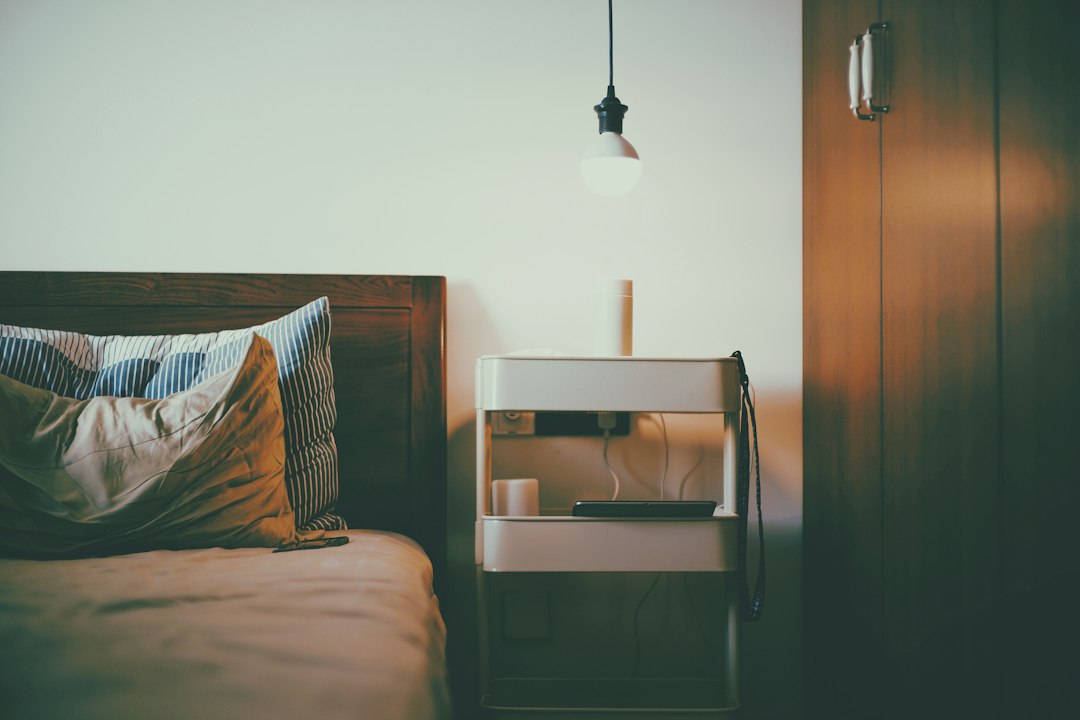
5. Replace One Bulky Nightstand With a Floating Shelf
A wall-mounted shelf can hold a phone, book, glasses, and small lamp while exposing more floor. It is especially useful on the tighter side of the bed.
Do not assume floating automatically means better. If you need drawers for medication, chargers, or personal items, one slim nightstand with closed storage may be more useful than a pretty shelf that leaves everything visible.
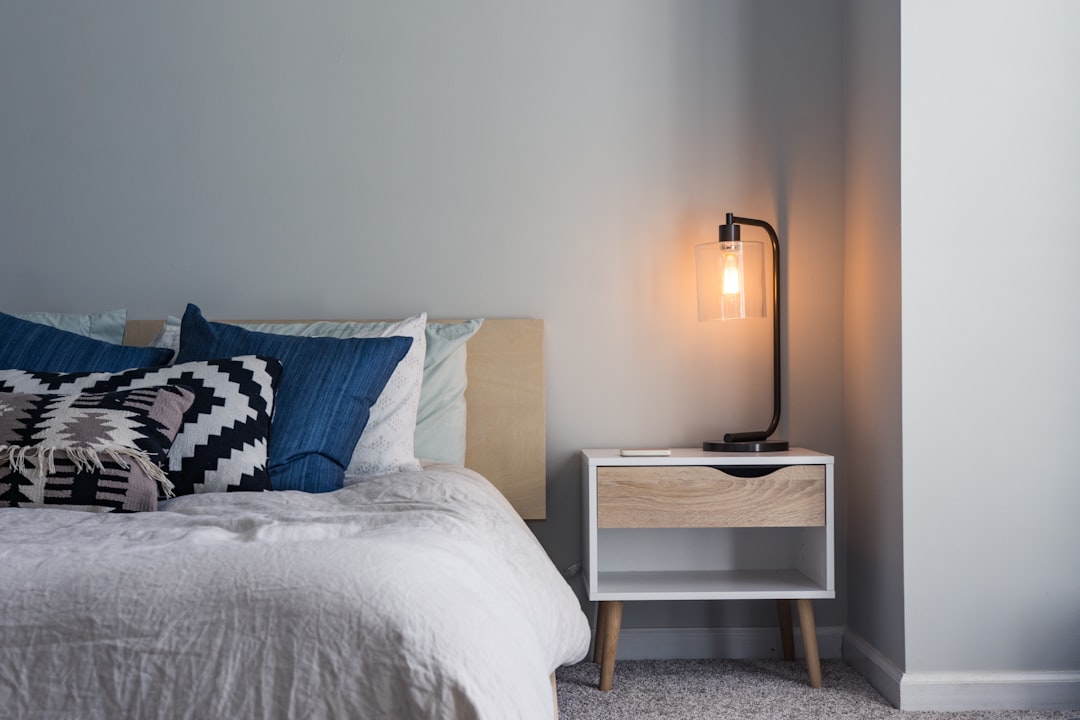
6. Move Bedside Lighting Off the Nightstand
Wall sconces, plug-in sconces, or small pendants can free the top of a tiny bedside table. They also reduce the number of bases and cords competing for space.
Choose fixtures that put light where you actually read rather than simply placing them high for decoration.
7. Use Vertical Storage Where Floor Space Is Truly Limited
Take storage upward instead of adding more low furniture. A tall narrow bookcase, wall shelf above a dresser, or cabinets over a desk can add capacity without increasing the footprint.
Keep the highest storage for items you use less often so daily objects stay within comfortable reach.
8. Keep the Window Wall Visually Light
Natural light has an outsized effect in a small bedroom. Avoid placing the room’s heaviest wardrobe or shelving unit where it unnecessarily blocks the main window or darkens the longest sightline.
If furniture must sit near the window, compare a lower dresser or narrower piece before choosing a tall cabinet.
9. Hang Curtains to Reveal More of the Glass
Where wall space allows, mount the rod so open curtains stack mostly beside the window instead of covering it. Floor-length curtains can also create a stronger vertical line and make the wall feel taller.
Measure first. “High and wide” is useful only when the room actually has enough side wall and ceiling clearance.
10. Use a Limited Palette, Then Add Depth With Texture
A small bedroom does not have to be white. What helps most is visual continuity. Choose a base color, one supporting tone, and one or two accents, then repeat them through bedding, curtains, rugs, art, and small accessories.
Add interest with linen, wool, wood, woven baskets, boucle, ceramic, or metal rather than adding a new color every time the room feels plain.
Keep: one main color family + repeated materials + a few intentional accents.
Avoid: unrelated colors on every wall, pillow, basket, rug, and storage box.
Cohesion reduces visual breaks, which helps the room feel calmer and more spacious.
11. Let Bedding Do Most of the Decorating
The bed is already the largest visual surface, so use it. A well-chosen duvet, coverlet, blanket, and two or three useful pillows can carry more decorative weight than adding objects to every surface.
In a very small room, simpler bedding often looks more luxurious because there is less competition around it.
12. Use One Larger Rug Instead of Several Tiny Ones
Multiple small rugs break the floor into pieces. One rug that visually connects the bed area usually feels calmer.
If the room is too tight for a large rug under most of the bed, use a runner along the side you step out of every morning rather than forcing a rug that bunches under furniture.
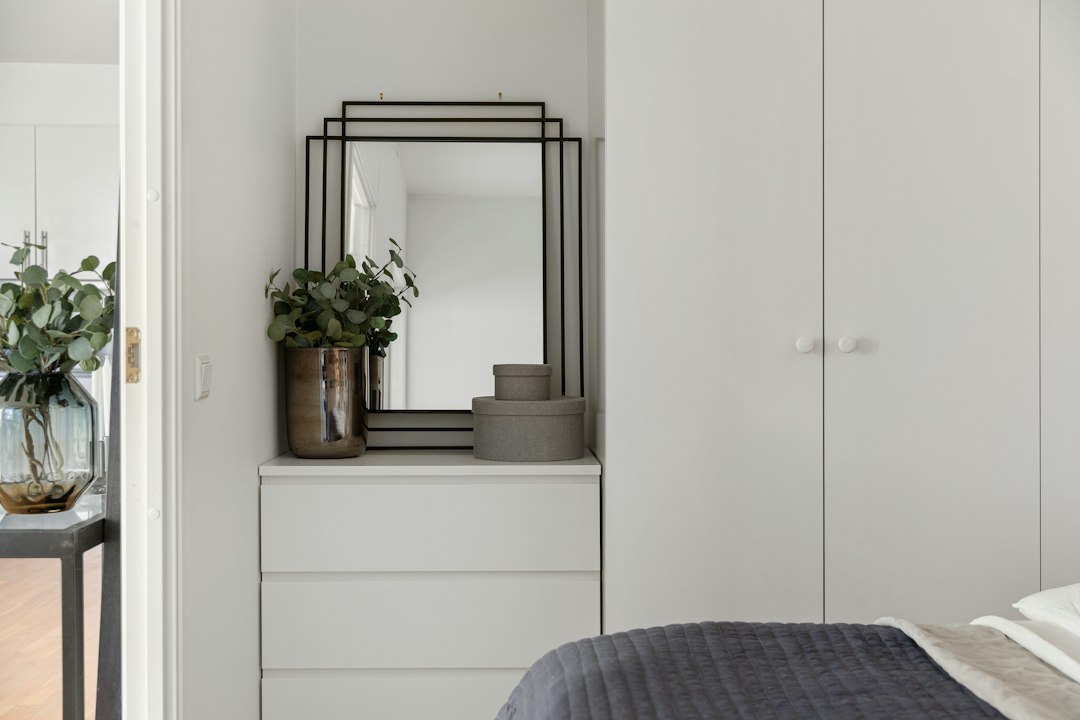
13. Put a Mirror Where It Reflects Light or an Open View
A mirror helps most when it reflects a window, bright wall, doorway, or open portion of the room. A mirror facing clutter simply doubles the clutter.
One larger mirror often creates more visual depth than a collection of small mirrors scattered around the walls.
14. Keep Open Storage Curated
Open shelves can make a bedroom feel personal, but they also increase visual information. Use them for books, a few meaningful objects, or attractive everyday items—not every category you own.
For visually mixed categories such as cables, toiletries, paperwork, or accessories, closed drawers and baskets usually create a calmer result.
15. Choose a Dresser Based on Wall Efficiency, Not Just Capacity
A wide, shallow dresser may work better than a deep chest if it leaves more circulation. In another room, a tall chest can use vertical space better and free a short wall for something else.
Measure drawer pull-out depth as well as the furniture depth. A dresser is not functional if the lower drawers hit the bed every time you open them.
16. Use the Back of the Door for Low-Profile Storage
Hooks or a shallow over-door organizer can hold robes, bags, belts, or tomorrow’s outfit without using wall or floor space.
Keep the load visually simple. A door covered in twenty mixed items becomes a clutter wall every time you enter the room.
17. Make a Small Desk or Vanity Do Two Jobs
If you need a work surface, choose one that can also function as a dressing table, bedside surface, or console. A narrow desk with drawers can outperform a separate desk plus vanity.
When work ends, put the laptop and cables away so the bedroom can visually return to a resting space.
18. Mount the TV Only if It Solves a Real Furniture Problem
Wall-mounting a television can eliminate a media console, but it is not automatically the best choice. If you still need the console for clothing or storage, mounting the screen may not save anything.
Decide based on whether the floor furniture disappears—not just whether the screen moves upward.
19. Decorate the Wall Above the Bed as One Composition
Instead of scattering several unrelated pieces around the room, make the headboard wall the main decorative moment. Use one larger artwork, a textile, a compact gallery, or a painted treatment.
This gives the room a focal point without filling every wall.
20. Leave Some Surfaces Intentionally Empty
A clear dresser corner, empty portion of wall, or partially open shelf gives the eye somewhere to rest. In a small room, negative space makes the decorated areas feel more deliberate.
Do not treat every blank surface as a decorating problem.
21. Edit the Room After You Finish Decorating
Small bedrooms often improve most during the final edit. Remove one lamp, basket, pillow, framed print, or piece of furniture and see whether the room functions better without it.
If the answer is yes, the room did not need more styling—it needed less visual friction.
What Colors Make a Small Bedroom Look Bigger?
Light colors can reflect more light, but they are not the only option. A small bedroom can work beautifully in sage, dusty blue, warm taupe, clay, soft gray, muted green, or even a deeper color when the palette is cohesive.
The bigger issue is contrast. Strong visual breaks between walls, furniture, storage, and textiles can make the room feel chopped up. If your goal is spaciousness, use neighboring tones and let texture provide depth.
| Goal | Color approach | Why it helps |
|---|---|---|
| Bright and airy | Warm white + pale wood + soft accent | Reflects light and reduces contrast |
| Calm and natural | Sage + cream + oak | Creates continuity without feeling sterile |
| Cozy but not cramped | Muted mid-tone walls + similar bedding | Reduces harsh wall-to-furniture contrast |
| Moody bedroom | Deep wall color + tonal textiles + controlled lighting | Can feel intentional if the palette stays cohesive |
How to Make a Small Bedroom Look Bigger Without Remodeling
If your goal is visual spaciousness, focus on the things that interrupt the eye: bulky furniture, broken sightlines, exposed clutter, blocked windows, too many colors, and poor lighting.
- Clear the main route from the door to the bed and closet.
- Reduce or relocate the bulkiest unnecessary furniture.
- Expose more floor where possible.
- Open the window visually with better curtain placement.
- Use at least two or three light sources instead of one harsh ceiling light.
- Group decor into fewer, stronger focal points.
- Hide visually inconsistent categories in closed storage.
Three Small Bedroom Scenarios
A 9-by-10 bedroom with a queen bed
Start by testing the queen on the longest clear wall. If two nightstands create narrow unusable gaps, use one 18–24 inch nightstand and one floating shelf. Move lighting to the wall, keep the window clear, and choose a dresser only after you confirm drawer clearance.
A narrow bedroom where the bed nearly fills the width
Prioritize the route along one side instead of forcing equal clearance on both. Keep that route free of baskets and furniture, use a wall shelf or narrow ledge on the tight side, and let the headboard wall carry most of the decoration.
A small bedroom that also has to function as an office
Use one narrow desk with drawers rather than a desk plus separate vanity. Place it where the chair can tuck in completely. Use a task light that does not spill across the bed, and create a shutdown routine so work equipment disappears at night.
Small Bedroom Decorating Mistakes to Avoid
- Buying smaller versions of everything. Too many small pieces can create more clutter than a few appropriately scaled ones.
- Forcing two nightstands. Symmetry is optional; usable space is not.
- Blocking the window with tall furniture. Natural light is one of the room’s best assets.
- Using open storage for messy categories. Visible variety quickly becomes visual noise.
- Ignoring drawer and door clearance. Furniture that technically fits can still make the room unusable.
- Decorating before fixing circulation. Accessories cannot compensate for a bad furniture layout.
- Assuming white is mandatory. Cohesion and scale matter more than a specific paint color.
A One-Weekend Small Bedroom Reset
- Friday: photograph the room from the doorway and remove anything that does not belong in the bedroom.
- Saturday morning: test the bed position and clear the main walking route.
- Saturday afternoon: edit furniture, relocate bulky pieces, and solve visible clutter.
- Saturday evening: evaluate lighting with the overhead light off and note dark zones.
- Sunday morning: restyle bedding, curtains, rug, and one main wall.
- Sunday afternoon: buy only the missing items that solve a measured problem.
Ask: Does it improve sleep, storage, lighting, circulation, or the main focal point?
If the answer is no and it only fills a blank surface, leave the space empty for a week before buying it.
Frequently Asked Questions
How do I decorate a small bedroom without making it cluttered?
Start with the bed and walking path, then use a limited palette, closed storage for visually mixed categories, fewer larger decorative moments, and some intentionally empty surfaces. Keep the window visually open and avoid adding small furniture just because a corner is empty.
Should a small bedroom have a dark or light color?
Either can work. Light colors reflect more light, while deeper colors can create a cozy, intentional room. Cohesion matters more than following a rule. If you use darker walls, keep the textiles and furniture palette controlled and make sure the lighting is strong enough.
Where should the bed go in a small bedroom?
Start with the longest uninterrupted wall and test circulation to the door, closet, drawers, and window. Centering the bed is not required. An off-center bed can be more functional if it creates one useful bedside zone instead of two narrow gaps.
How do I make a small bedroom look bigger?
Protect the main walking route, expose more continuous floor, keep the window clear, use mirrors to reflect useful light, reduce visual clutter, repeat colors and materials, and avoid unnecessary bulky furniture. Layered lighting also helps the room feel less flat and boxed in.
What furniture should I avoid in a small bedroom?
Avoid pieces that block circulation or duplicate a function you already have. Common offenders are oversized bed frames, deep dressers that cannot open fully, two nightstands when one would work, fixed benches at the foot of the bed, and decorative chairs that become clothes storage.
How can I decorate a small bedroom on a budget?
Rearrange the bed first, remove visual clutter, improve the bedding, move lamps or add inexpensive plug-in sconces, hang curtains to reveal more glass, and group existing art instead of buying more accessories. Spend only after you identify a specific remaining problem.
The Bottom Line
The best way to decorate a small bedroom is to make the room work first and style it second. Place the bed carefully, protect circulation and daylight, keep furniture visually light, move storage upward when useful, layer lighting, repeat a limited palette, and let the bed and one main wall do most of the decorative work.
A small bedroom does not need to feel sparse. It needs to feel intentional.