


Decorating a small apartment is not really a question of how many clever objects you can squeeze into it. The bigger challenge is deciding what deserves space, how people will move through the rooms, and how to make storage, furniture, lighting, and personality work together.
This guide is designed as a practical decorating system rather than a list of pretty ideas. It works for studios, one-bedroom apartments, renters, and anyone trying to make limited square footage feel intentional instead of cramped.

Quick Answer: How Should You Decorate a Small Apartment?
Start with function before decor. Measure the apartment, identify clear walking paths, decide what each zone needs to do, and remove items that do not earn their space. Then choose properly scaled furniture, use vertical and hidden storage, layer the lighting, repeat a limited color palette, and finish with a smaller number of meaningful decorative pieces.
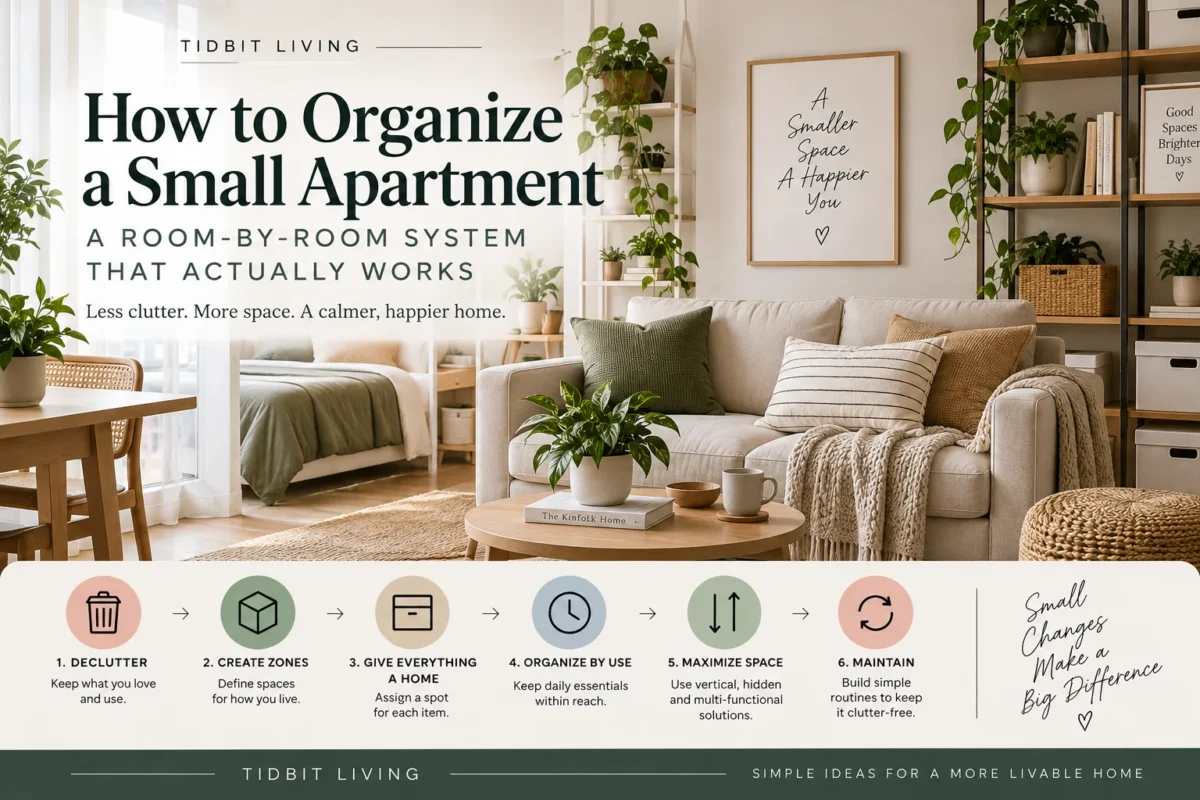
A useful order is Measure → Edit → Zone → Layout → Storage → Lighting → Textiles → Personality. Following that sequence prevents one of the most common small-space mistakes: buying attractive decor before solving the layout.
Small Apartment Decorating Priorities at a Glance
| Problem | Prioritize | Avoid |
|---|---|---|
| Room feels cramped | Clear paths, fewer pieces, visible floor | Too much small furniture |
| Room feels dark | Layered lighting, mirrors, lighter surfaces | One harsh ceiling light |
| Not enough storage | Vertical, hidden and multifunctional storage | Random bins without a plan |
| Studio lacks separation | Rugs, furniture placement, lighting zones | Bulky dividers that block light |
| Rental feels generic | Textiles, art, removable treatments, lamps | Changes that violate the lease |
| Apartment looks cluttered | Closed storage and larger visual groupings | Decor on every surface |
Before You Decorate: Measure the Apartment Like a Designer
Measurements matter more in a compact apartment because a difference of a few inches can determine whether a door opens, a chair pulls out, or a walkway feels comfortable. Record wall lengths, ceiling height, windows, doors, radiators, outlets, and any architectural projections before shopping.
Do not measure only the empty spot where a piece will sit. Also measure the route the furniture must travel through, including the building entrance, elevator, stairwell, hallway, and apartment doorway.

Map the traffic paths
Walk through your normal routine: front door to kitchen, sofa to bathroom, bed to closet, desk to kitchen. Those routes should remain as unobstructed as possible. As a practical planning target, aim for roughly 30–36 inches (76–91 cm) for important passageways where your layout permits. In very tight areas you may have less, but the point is to consciously protect circulation rather than fill every available inch.
Use painter’s tape before buying furniture
Mark the proposed sofa, table, bed, or cabinet footprint on the floor. Then live around the outline for a day. Open nearby drawers and doors. Pull a dining chair back. Walk past it carrying laundry. This simple test reveals problems that a product photo cannot.
21 Small Apartment Decorating Ideas That Solve Real Problems
1. Edit the room before adding anything
Small rooms amplify visual noise. Before buying decor, remove items that have no useful or emotional role, then clear temporary clutter from tables, counters, chairs, and the floor. You are not trying to create an empty minimalist apartment; you are creating enough visual breathing room for the pieces you actually like to register.
A helpful test is to photograph the room from the doorway. The photo often makes crowded surfaces, undersized rugs, awkward furniture angles, and random objects easier to notice.
2. Choose a cohesive palette, not necessarily an all-white one
Light colors can reflect available light, but a small apartment does not have to be white. A cohesive palette matters more than following a rule that every compact room must be pale. Choose a base neutral or dominant color, one supporting color, and one or two accents. Repeat them across adjacent areas so the eye reads the apartment as a connected whole.
If you prefer dark or saturated colors, use them intentionally. A deep color can make a small bedroom or nook feel enveloping rather than cramped when the lighting and furnishings support it. The goal is coherence, not fear of color.
3. Use furniture scale, not simply ‘small furniture’
Filling a compact living room with many miniature pieces can make it look busier and less comfortable. A properly proportioned sofa plus one useful chair may work better than a tiny loveseat surrounded by several small stools and tables.
Think in relationships: sofa to wall, coffee table to sofa, rug to seating group, bed to nightstands. A piece should leave enough circulation while still looking substantial enough for its job. If choosing between several marginal pieces and one strong functional piece, the latter often produces a calmer room.
4. Protect visible floor area
Seeing more continuous floor helps a compact room feel easier to read. Furniture with legs, wall-mounted nightstands, floating shelves, slim consoles, and raised cabinets can preserve that visual continuity. This does not mean every item needs skinny legs; use the technique where bulky furniture is making a room feel heavy.
5. Let furniture do more than one job
A small apartment benefits when one footprint serves multiple functions. Consider a storage ottoman that is also extra seating, a console that becomes a laptop desk, a drop-leaf table that handles meals and work, or a storage bench that provides both seating and hidden organization.
Multifunctional furniture is most valuable when both functions are genuinely useful. A complicated convertible piece you dislike operating is not space-saving if you never convert it.
6. Use vertical space selectively
Tall shelving and wall-mounted storage can add capacity without consuming much floor area. Vertical artwork and curtains mounted high can also emphasize height. But covering every wall with shelves can make a small apartment feel like a stockroom. Combine useful vertical storage with intentionally empty wall areas.
If organization is the bigger problem, our guide to the best storage solutions for small apartments goes deeper into under-bed storage, shelving, carts, closed storage, and room-specific systems.
7. Use mirrors where they can reflect something useful
A mirror is most effective when it reflects daylight, a pleasant view, artwork, or an open portion of the room. Placing one opposite clutter simply doubles the clutter visually. Before mounting a large mirror, stand where it will go and check what it will actually reflect.
One larger mirror often has more impact than a collection of small mirrors because it creates a broader reflected view with fewer visual interruptions.
8. Hang curtains to emphasize the window, not shrink it
When the architecture allows, position the curtain rod above the window frame and extend it beyond the glass so open curtains stack mostly beside the window instead of covering it. This can expose more daylight and give the window greater visual presence.
Floor-length curtains usually create a cleaner vertical line than curtains ending awkwardly below the sill. Always measure the actual window and wall before ordering rather than relying on generic curtain advice.
9. Layer lighting instead of depending on the ceiling fixture
Small apartments often have one central ceiling light that illuminates everything equally and flatly. Add lighting at different heights: a floor lamp near seating, a table lamp on a console, a task light at a desk, or plug-in sconces near the bed. Multiple pools of light create depth and let different zones function independently.
For rentals, plug-in sconces and floor lamps can provide the effect of built-in lighting without rewiring.
10. Size the rug to the furniture group
A rug should visually connect a seating area rather than float like a small island in the middle. In many living rooms, placing at least the front legs of the main seating pieces on the rug creates a more unified zone. Before buying, tape the rug dimensions on the floor and compare them with the sofa and chairs.
If a larger rug exceeds the budget, it can be better to wait than to buy a tiny rug simply because it is cheaper. Rug scale has an outsized effect on how finished a room feels.
11. Create zones without building walls
In a studio, use orientation and visual cues before reaching for a room divider. Turn the sofa so its back helps define the living zone, place a rug under the seating area, use a pendant or table lamp to establish a dining zone, and position the bed so it feels intentionally separate.
A tall opaque divider can solve privacy but also block daylight. Open shelving, curtains, screens, or strategic furniture placement may preserve more light and flexibility.
12. Choose closed storage for visually messy categories
Open shelves work well for books, attractive objects, and frequently used items that can stay orderly. They are less successful for mixed cables, toiletries, paperwork, cleaning products, and miscellaneous household supplies. Put visually inconsistent categories behind doors, inside drawers, or in matching baskets.
The objective is not to hide everything. A useful balance is display what improves the room; conceal what merely needs a home.
13. Group decor instead of scattering it
Five unrelated objects spread across five surfaces create more visual noise than the same number arranged as one intentional composition. Try grouping books, a lamp, and one decorative object on a console, then leave another surface relatively clear.
Trays can help contain small objects, but do not use a tray as permission to keep unlimited clutter. The grouping should still have a purpose.
14. Decorate with fewer, larger pieces
One substantial artwork can be calmer than a dozen tiny frames. One healthy floor plant can have more presence than many small pots. One sculptural lamp can provide function and character simultaneously. Larger pieces can actually make a small room feel more deliberate when their scale is appropriate.
15. Add texture when you want interest without visual chaos
If the palette is restrained, texture keeps the apartment from feeling flat. Mix materials such as linen, wood, woven fibers, glass, ceramic, metal, and soft upholstery. Repeating a few textures across rooms creates depth without introducing a new color or pattern at every turn.
16. Treat plants as furniture, not filler
Choose plant size and location based on available light and floor space. A tall plant can soften an unused corner; a trailing plant can use vertical space; herbs can add function in a bright kitchen. Avoid collecting plants for every empty surface if caring for them creates clutter or blocks useful workspace.
17. Use wall-mounted pieces where the floor is the bottleneck
Floating nightstands, shelves, wall lights, and folding wall desks are particularly useful in narrow bedrooms and work areas. They preserve floor area and can make cleaning easier. Renters should verify mounting rules and use hardware appropriate for the wall and load.

18. Make renter-friendly changes high-impact and reversible
Start with items that move with you: curtains, rugs, lighting, art, mirrors, bedding, hardware you can reinstall later, and freestanding storage. Removable wallpaper or peel-and-stick products can transform a room, but adhesion varies by paint and surface. Test a hidden patch first and follow both the product instructions and lease requirements.
19. Create one focal point per main zone
A focal point gives the eye somewhere to settle. In the living room it might be artwork, a rug, a media wall, or the view. In a bedroom it may be the headboard or bedding. When everything is trying to be the statement, nothing feels important.
20. Use awkward architecture instead of fighting it
Small apartments often have radiators, columns, sloped ceilings, shallow niches, strange corners, or off-center windows. Measure these features and assign them a role. A shallow niche might hold a narrow shelf; a corner may suit a reading chair; an alcove can become a desk. Custom-looking solutions often begin by accepting the room’s quirks.
21. Leave deliberate empty space
Negative space is functional. It makes doors easier to open, pathways easier to navigate, and decorative pieces easier to appreciate. You do not need to fill every wall or corner just because it is technically available.

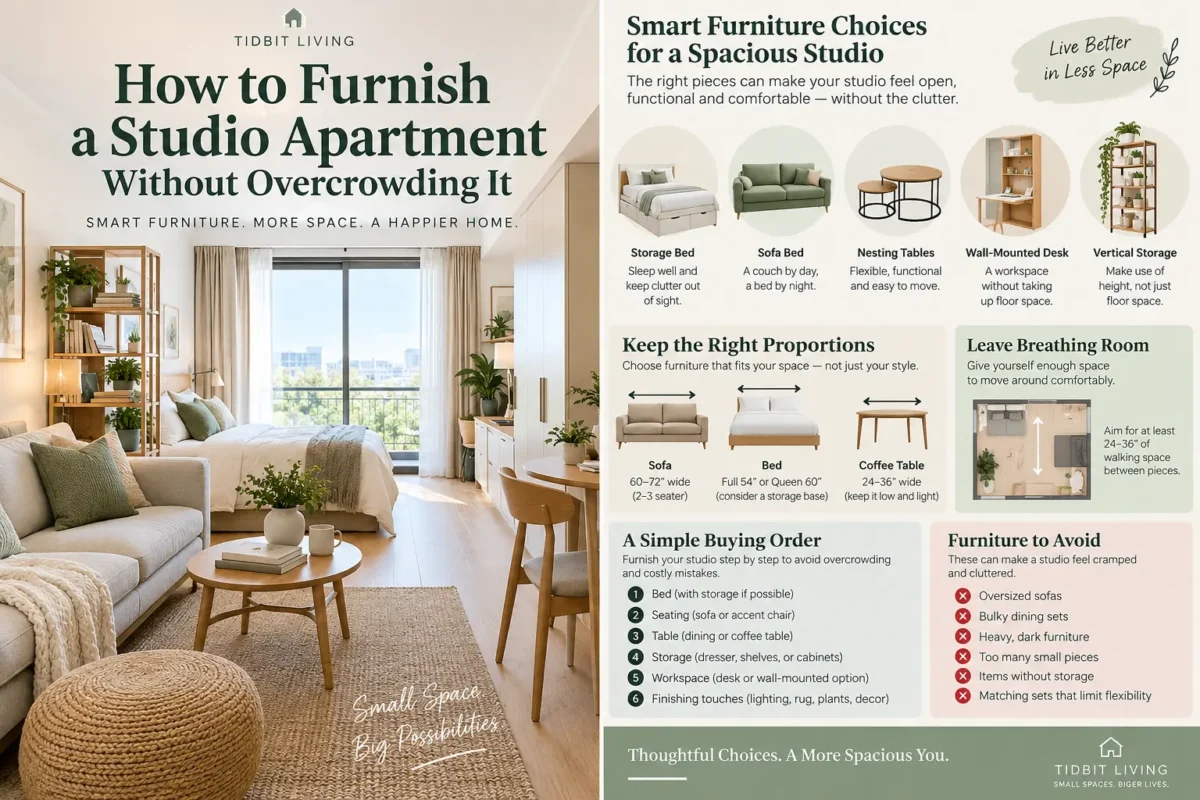
Small Apartment Furniture Sizing: Practical Rules
Exact dimensions depend on your apartment, but these planning guidelines can help you evaluate whether pieces work together.
| Area | Useful Planning Guideline | Why It Matters |
|---|---|---|
| Main walkway | Aim for about 30–36 in (76–91 cm) where possible | Allows easier everyday circulation |
| Coffee table to sofa | Often about 14–18 in (36–46 cm) | Keeps the table reachable without crowding legs |
| Dining chair clearance | Plan roughly 30–36 in behind chairs when space permits | Gives room to pull chairs out and pass |
| Bedside passage | Protect enough room for comfortable entry and drawer/door opening | A bed that technically fits can still make a bedroom unusable |
| Living-room rug | Prefer a size that connects the main seating group | Prevents the room from looking visually chopped up |
These are planning targets, not building-code requirements. Very small apartments may require tighter spacing. Always prioritize safe movement, door operation, accessibility needs, and the way you actually use the room.
Tidbit Living Quick Visual: Furniture Spacing Guide
| Keep this space clear | Useful target |
|---|---|
| Sofa to coffee table | 14–18 in (36–46 cm) |
| Main walking path | 30–36 in (76–91 cm) where possible |
| Behind dining chairs | 30–36 in (76–91 cm) when space allows |
| Rug under seating | At minimum, connect the main seating group with the front legs on the rug |
| Bedside clearance | Enough for comfortable entry plus drawers/doors to open fully |
Use this as a planning check, not a rigid rule. Tape furniture footprints on the floor before buying and test how the room actually feels to walk through.

How to Decorate a Studio Apartment
A studio has a different problem from a small one-bedroom: several activities share one visual field. The goal is not to pretend the studio has separate rooms. It is to make each function legible without breaking the apartment into tiny boxes.
Start with the bed
The bed is usually the largest fixed footprint. Position it first, then build the living and work zones around the remaining circulation. If possible, avoid placing the bed where it blocks the strongest natural-light path.
Create separation with orientation
Turn furniture to establish boundaries. A sofa facing away from the bed can define the living area. A rug can mark the seating zone. A narrow console behind the sofa can create a subtle transition while providing storage or a work surface.
Repeat colors across zones
Zones should feel distinct but related. Repeating the same wood tone, metal finish, or accent color in the sleeping and living areas keeps the studio from looking like several unrelated rooms squeezed together.
How to Decorate a Small One-Bedroom Apartment
With a separate bedroom, resist the urge to make every room do everything. Let the living room prioritize relaxing, entertaining, and perhaps dining; let the bedroom prioritize sleep and clothing storage. If you need a workspace, decide which room can absorb it with the least disruption.
Use visual continuity between rooms—similar undertones, repeated materials, or related textiles—but allow each room one distinctive feature. That creates personality without making the apartment feel fragmented.
Room-by-Room Small Apartment Decorating Plan
Small living room
Start with seating and circulation. Choose the sofa based on the wall and pathway rather than the maximum sofa you can physically squeeze through the door. Add only the tables you actually use. If storage is necessary, favor a media cabinet, ottoman, or sideboard that hides mixed items.
Then add a correctly scaled rug, layered lighting, one focal point, and enough empty space for the seating arrangement to breathe.
Small bedroom
Protect sleep and movement first. If the room is narrow, wall-mounted lights and small floating nightstands can free floor area. Use the space under the bed for low-frequency items rather than adding another bulky cabinet. Keep the top of the dresser relatively calm because it is often one of the largest visible surfaces.
Small kitchen
Decorating should not consume valuable prep space. Let functional objects provide some of the style: attractive cutting boards, a compact fruit bowl, one useful tray, or a small piece of art placed away from heat and moisture. Keep counters clearer by improving cabinet and vertical storage before adding decorative accessories.
Small bathroom
Use a restrained palette and reduce the number of product bottles on display. A mirror with presence, good lighting, matching towels, and one or two intentional accessories can do more than many tiny decorations. Freestanding over-toilet storage or slim cabinets can help where built-ins are limited.
Small entryway
Even a wall beside the door can function as an entryway. Give everyday objects an assigned landing zone: hooks for frequently used bags or coats, a small tray for keys, slim shoe storage, and perhaps a mirror. The best entryway prevents clutter from migrating into the rest of the apartment.
How to Make a Small Apartment Look Bigger
No decorating trick changes the actual square footage, but several choices can reduce visual obstruction and make the apartment feel more open:
- Keep important walking paths clear.
- Expose more continuous floor where possible.
- Use mirrors to reflect daylight or an open view.
- Hang curtains to reveal as much window glass as practical.
- Use a limited palette across connected spaces.
- Choose a few appropriately scaled pieces instead of many undersized ones.
- Reduce surface clutter and use closed storage for mixed categories.
- Use several light sources rather than one harsh overhead fixture.
The strongest result usually comes from combining several of these principles rather than relying on a single ‘make your room look bigger’ trick.
Tidbit Living Quick Visual: 6 Ways to Make a Small Apartment Feel Bigger
- Go vertical: use tall shelving, higher curtain placement, and vertical art to draw the eye upward.
- Reflect useful views: position mirrors to bounce daylight or an open sightline, not clutter.
- Show more floor: furniture with visible legs can reduce visual weight.
- Use a larger rug: connect the main furniture group instead of visually chopping the room into tiny pieces.
- Protect sightlines: avoid tall, bulky objects where they block light or the longest view through the apartment.
- Reduce surface clutter: keep key counters, tables, and dressers visually calm and move mixed items into closed storage.
Best result: combine several of these ideas instead of expecting one decorating trick to transform the whole apartment.
Small Apartment Decorating on a Budget
Spend in the order that changes how the apartment functions. Rearranging and editing are free; fixing an undersized rug or poor lighting can transform a room more than buying ten decorative accessories.
If you have about $100
- Declutter and rearrange first.
- Replace mismatched storage on one highly visible surface.
- Add a lamp or improve bulbs where lighting is weak.
- Buy or thrift one larger piece of art rather than many small objects.
- Use pillow covers or a throw to repeat your chosen palette.
If you have about $500
- Address the room’s biggest scale problem, such as an undersized rug.
- Add a substantial mirror if the placement will reflect light or an open view.
- Upgrade curtains and rods where window treatment is weakening the room.
- Add one useful storage piece that replaces visible clutter.
If you have about $1,000
Do not automatically spend the entire amount. First identify the piece causing the biggest functional problem. A correctly scaled sofa, storage bed, dining table, or multifunctional cabinet may create more value than a full-room accessory refresh. Buy the foundational piece first, then use the remaining budget on lighting and textiles.
What to Buy First—and What Can Wait
| Buy/solve earlier | Usually can wait |
|---|---|
| Correctly scaled essential furniture | Decorative bowls and objects |
| Lighting needed for daily tasks | Trend-driven accent pieces |
| Window privacy/light control | Extra throw pillows |
| Storage for recurring clutter | More open shelving to style |
| A rug if it defines the main room | Small art bought only to fill gaps |
Common Small Apartment Decorating Mistakes
Buying before measuring
A beautiful piece is still the wrong piece if it blocks a path, radiator, outlet, cabinet, or door.
Assuming every piece must be tiny
Too many undersized objects can make a room feel fragmented. Scale pieces to one another and to the room.
Pushing everything against the walls
This sometimes creates more empty floor in the middle but an awkward perimeter of unrelated furniture. Test whether floating a sofa or chair slightly inward improves the grouping.
Adding storage without decluttering
More containers do not solve an excess of low-value belongings. Edit first, then design storage around what remains.
Using only open storage
Open shelves require visual discipline. Use closed storage for categories that are inherently inconsistent or unattractive.
Ignoring lighting until the end
Lighting changes color, atmosphere, usability, and perceived depth. Plan it as part of the room rather than as a final accessory.
Following ‘small-space rules’ too literally
Light paint, tiny furniture, and minimal decor are options—not laws. A small home can handle dark color, large art, pattern, and personality when the composition remains intentional and functional.
A Weekend Small Apartment Decorating Plan
- Friday evening: Measure rooms and photograph them from the main entrances.
- Saturday morning: Remove surface clutter and items you no longer want in each room.
- Saturday afternoon: Test furniture layouts using the pieces you already own.
- Saturday evening: Evaluate lighting after dark and note where task or ambient light is missing.
- Sunday morning: Decide which visible clutter needs closed or hidden storage.
- Sunday afternoon: Build a short shopping list in priority order, with exact maximum dimensions.
- Sunday evening: Style only after the functional problems are addressed.
This sequence can prevent impulse purchases because every item on the shopping list is connected to a problem you observed in the actual apartment.
Frequently Asked Questions
How do I decorate a small apartment without making it feel cluttered?
Use fewer decorative pieces, group small objects, protect empty surfaces, and put visually messy categories inside closed storage. Choose furniture according to the room’s scale and keep important paths clear.
What colors make a small apartment look bigger?
Lighter colors can reflect more available light, but there is no single color that automatically makes a room larger. A cohesive palette, adequate lighting, and reduced visual fragmentation usually matter more than simply painting everything white.
Should I use small furniture in a small apartment?
Use appropriately scaled furniture, not automatically tiny furniture. One comfortable sofa and a useful table can look calmer than several undersized pieces. Measure the room and preserve circulation before choosing dimensions.
How do I decorate a small apartment rental?
Prioritize movable and reversible improvements such as rugs, curtains, lamps, art, mirrors, freestanding storage, textiles, and furniture. For removable adhesives or peel-and-stick products, check the lease and test the surface first.
How can I decorate a studio so the bed is less dominant?
Create a distinct living zone with furniture orientation, a rug, and lighting. If privacy is important, consider an open shelf, curtain, or screen that separates the bed without unnecessarily blocking daylight.
What should I spend money on first?
Spend first on the item that fixes the biggest daily problem: essential furniture scale, lighting, privacy, a useful rug, or storage for recurring clutter. Accessories should come after the room functions well.
How much decor is too much in a small apartment?
There is no fixed number. Decor becomes too much when it interferes with useful surfaces, circulation, cleaning, storage access, or the ability to visually distinguish the pieces you care about.
Final Thoughts
The best small apartment decorating ideas are not tricks for disguising a small home. They are ways to make limited space work deliberately. Measure first, protect circulation, solve recurring clutter, choose furniture by scale and function, improve the lighting, and then add the colors, textiles, art, and objects that make the apartment feel like yours.
A compact home can be layered, colorful, comfortable, and personal. The goal is not to make it imitate a larger house. It is to make every square foot support the way you actually live.





One thought on “Small Apartment Decorating Ideas: 21 Ways to Make Your Space Feel Bigger and Better”
Comments are closed.