


A small guest bedroom has a different job from a primary bedroom. It does not need to hold everything a full-time bedroom does, but when someone stays overnight it should make the basics easy: sleeping well, charging a phone, setting down luggage, finding a towel, getting dressed, and having a little privacy. The best small guest bedroom ideas focus on those short-stay needs without filling the room with furniture that sits unused most of the year.
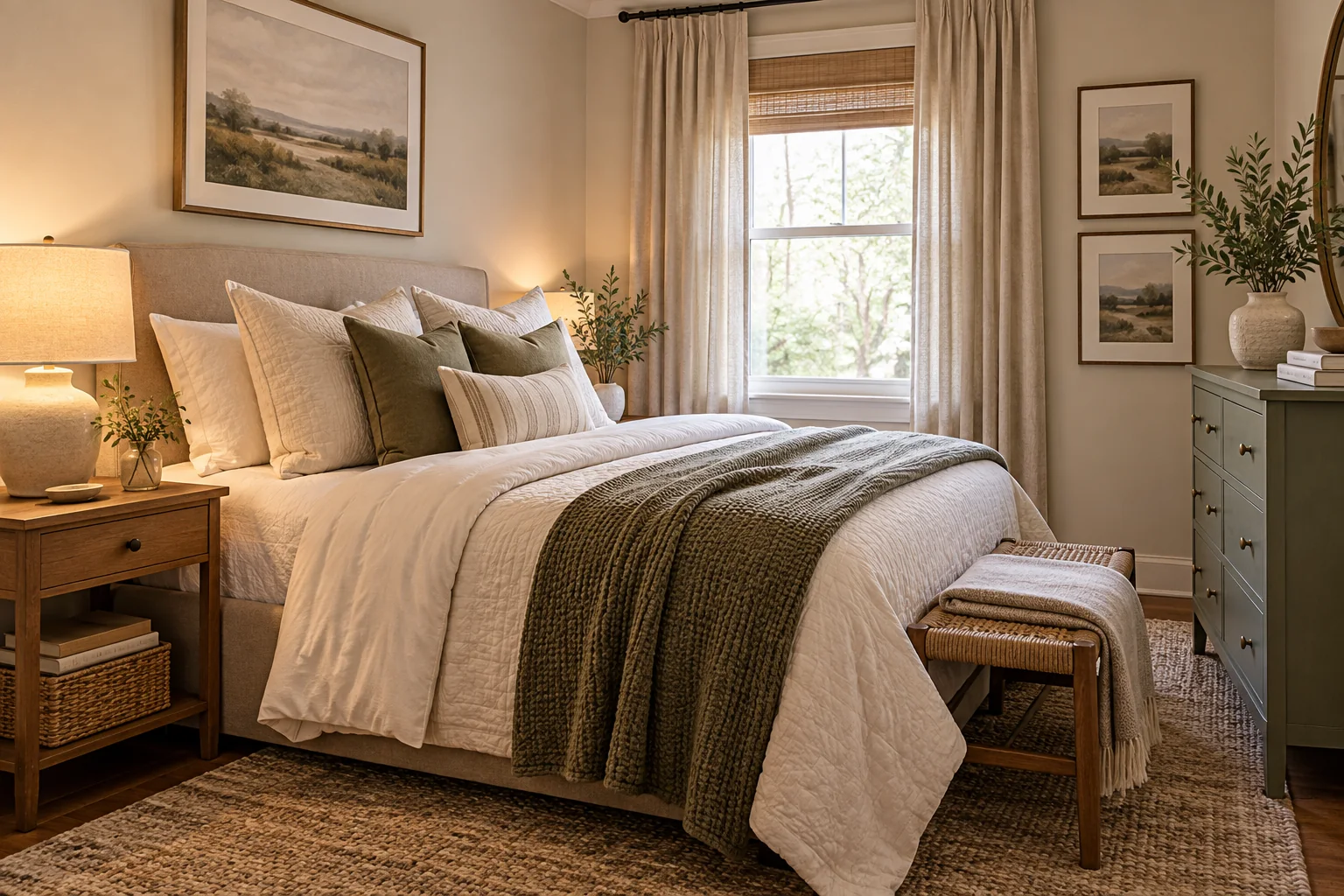
This guide is intentionally different from our small master bedroom ideas, small bedroom layout guide, and small-bedroom furniture buying guide. Here, the priority is short-stay comfort and flexible use: how to make a compact guest room feel welcoming without turning it into a storage room or sacrificing its everyday purpose.
What Does a Guest Actually Need in a Small Bedroom?
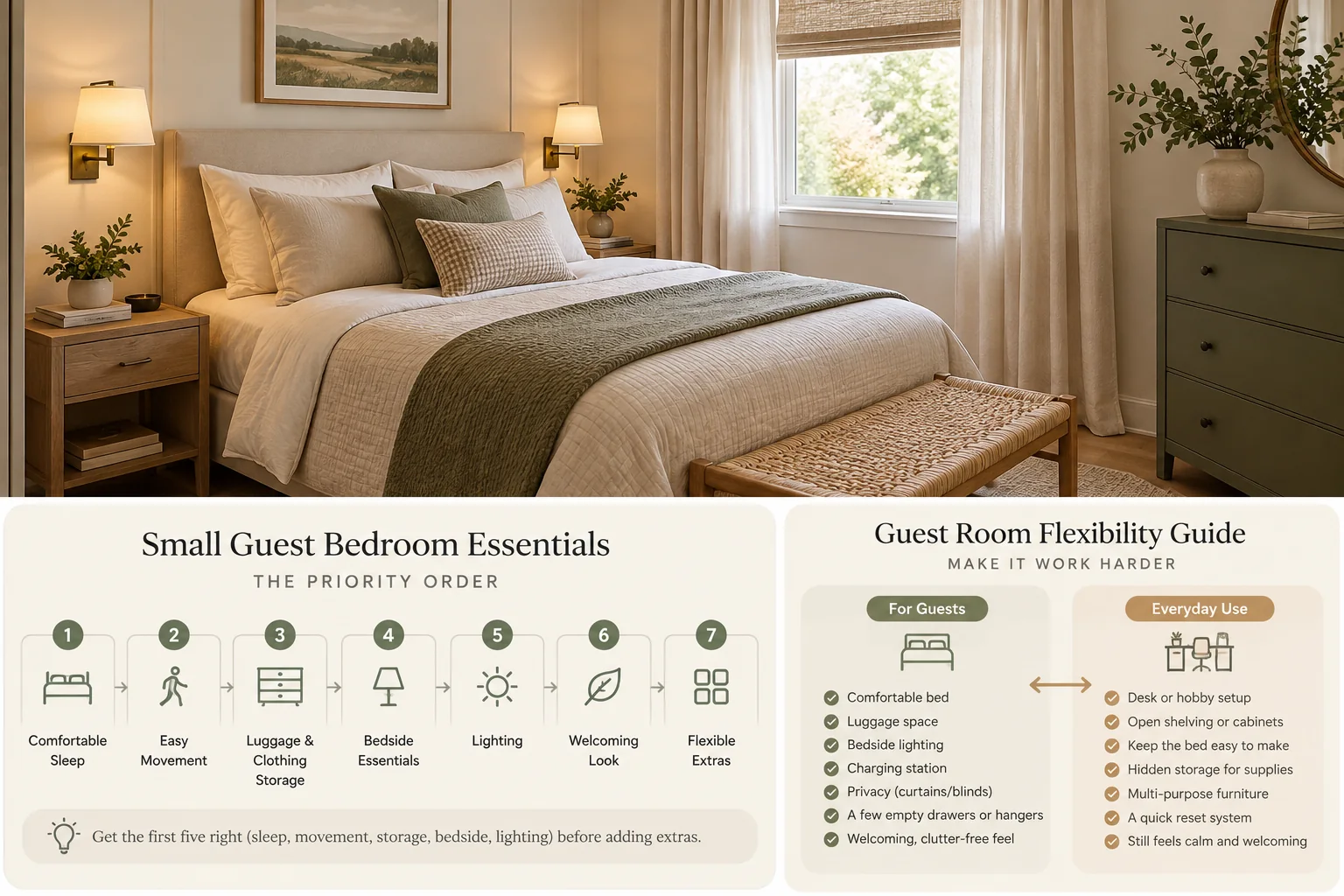
Most guests do not need a fully furnished bedroom. They need a small set of functions that are easy to understand without asking where everything is. If those basics are covered, the room usually feels thoughtful even when it is simple.
| Guest need | Small-space solution | Common mistake |
|---|---|---|
| Sleep comfortably | Supportive mattress, good pillows, breathable bedding | Prioritizing a decorative bed frame over mattress comfort |
| Set down belongings | One clear surface + luggage zone | Covering every surface with decor |
| Charge devices | Visible outlet, extension, or charging station | Making guests crawl behind furniture for power |
| Store a few clothes | Hooks, hangers, basket, or one empty drawer | Using the entire closet for household overflow |
| Control light and privacy | Bedside light + effective window covering | Decorative curtains that do not actually block light or views |
| Move comfortably | Clear route from door to bed and window | Adding a chair, bench, or desk that narrows circulation |
If the room cannot handle the first five comfortably, do not spend space on decorative furniture yet.
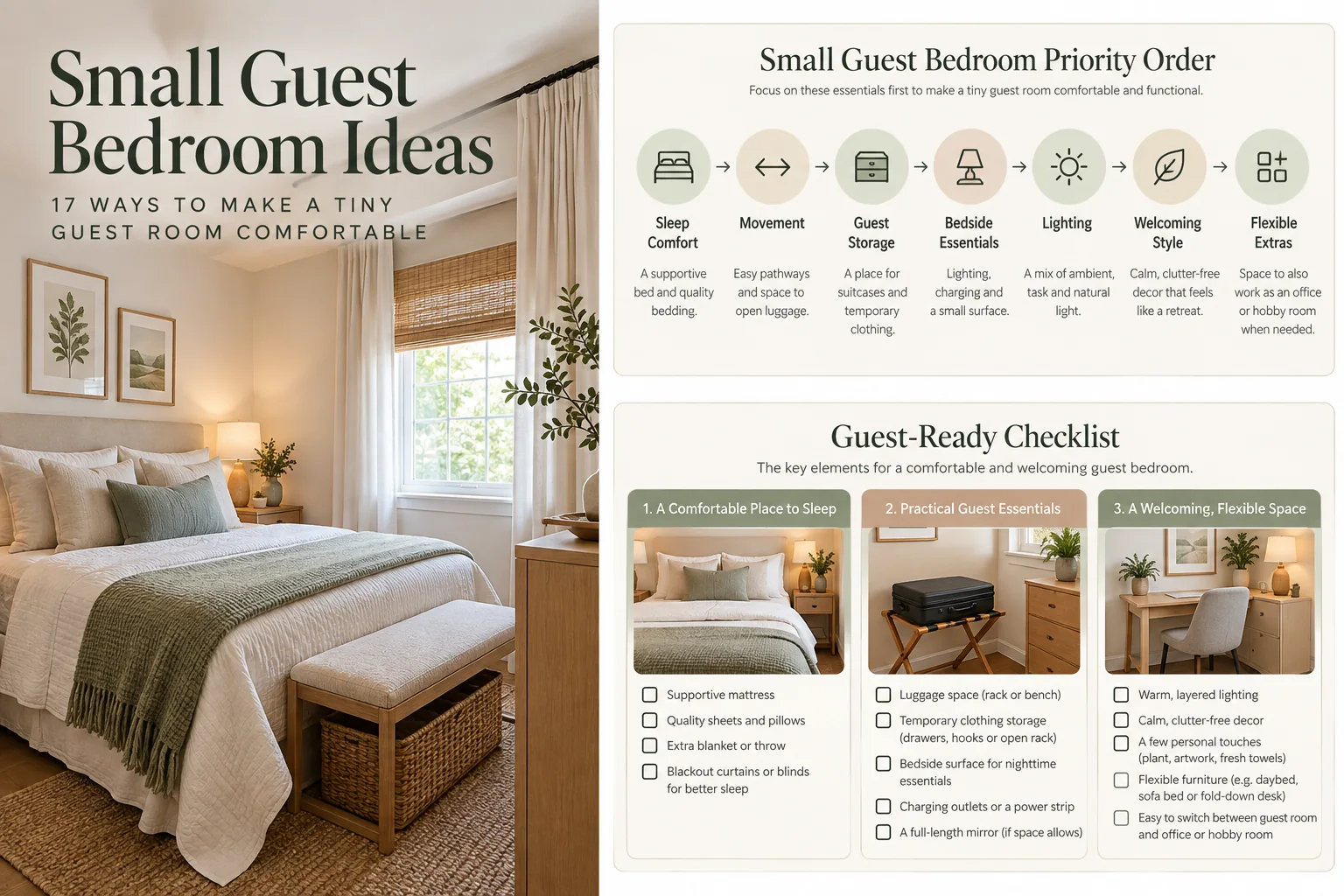
17 Small Guest Bedroom Ideas That Make Visitors More Comfortable
1. Spend your comfort budget on the mattress first
In a small guest room, the mattress matters more than an elaborate bed frame. If the room is used only occasionally, you do not need a luxury hotel setup, but the mattress should feel supportive, stable, and appropriate for adult sleepers. A simple platform frame with a good mattress is usually a better use of limited space than a bulky upholstered frame with mediocre sleep quality.
If the bed doubles as a daybed or sofa when guests are away, test it as a bed first. A piece that looks flexible but sleeps poorly fails the room’s main guest function.
2. Keep the bed easy to get into
Guests should not have to climb over luggage, squeeze past a desk chair, or step around a bench to reach the bed. Protect the clearest route from the door to the sleeping area. If only one side of the bed can be accessed, make that side genuinely usable rather than leaving a narrow token gap.
For rooms where placement is the main problem, use our small bedroom layout ideas to test the bed position before adding more furniture.
3. Give guests one clear bedside surface
A guest usually needs somewhere for a phone, glasses, water, medication, and perhaps a book. That surface can be a narrow nightstand, floating shelf, stool, or compact wall shelf. It does not need to match the other side of the bed.
The important part is that the surface is actually empty enough to use. A beautiful table covered with frames, candles, and decorative objects is less welcoming than a plain shelf with room for a glass of water.
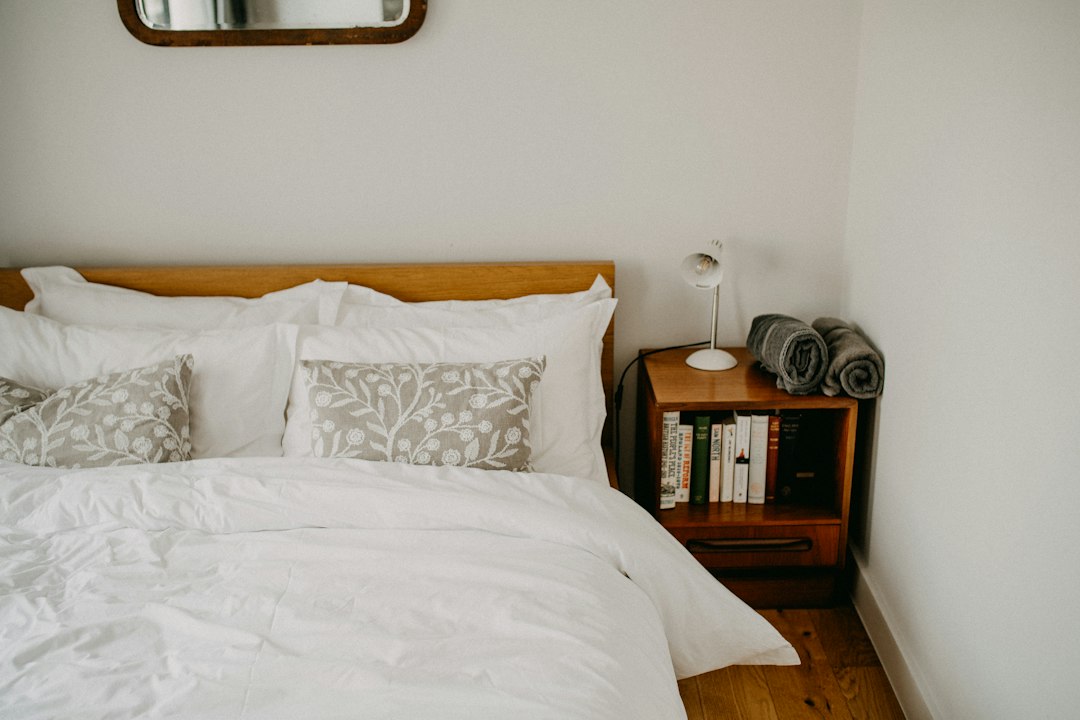
4. Make charging obvious
One of the easiest ways to make a guest room feel thoughtful is to make power easy to find. Put an extension cord, charging hub, or accessible outlet within reach of the bed. If the outlet is hidden behind furniture, route a cable to a visible spot instead of making guests move the nightstand.
A small tray labeled or visually grouped with the charging cable can keep the setup tidy without taking much space.
5. Create a real luggage zone
A suitcase on the floor can consume most of the usable area in a tiny room. Plan where luggage will go before a guest arrives. Good options include a folding luggage rack, a low clear shelf, the top of a sturdy bench that already earns its footprint, or a designated open section of floor that does not block the route to the bed.
Do not count the bed itself as the luggage zone if the guest has to move the suitcase every time they want to sleep.
6. Leave some closet space empty
A guest closet that is completely filled with household storage is not really guest storage. You do not need to empty the entire closet, but reserve a short hanging section with several empty hangers or provide hooks on the wall or back of the door.
If there is no closet, a row of sturdy hooks plus one basket can handle jackets, tomorrow’s clothes, and a handbag surprisingly well.
7. Give guests one place for folded clothes
Most short stays do not require a full dresser. One empty drawer, a shelf in the closet, or a clean basket is enough for folded clothes and small personal items. The goal is to give guests an alternative to living out of an open suitcase on the floor.
If the room already has a dresser, keep at least one drawer empty rather than using every drawer for seasonal household storage.
8. Use hooks where furniture would be overkill
Hooks are one of the most useful guest-room tools because they create temporary storage without occupying floor space. Use them for a robe, jacket, tote bag, hat, or tomorrow’s outfit. A few well-placed hooks can replace a chair that would otherwise become a clothing pile.
Place them where they do not interfere with the door swing or create a cluttered view from the hallway.
9. Put water and a simple welcome tray within reach
A guest should not have to explore the house at midnight for water. A small carafe, bottle, or glass on the bedside surface is enough. If you want to make the room feel more intentional, add only practical extras: tissues, a spare charging cable, the Wi-Fi name, or a small note about where towels are stored.
Keep the tray compact. The point is to reduce questions, not create another decorative display guests must work around.
10. Use bedside lighting that guests can control from bed
A ceiling light alone makes a guest room less comfortable at night. Add a lamp, wall sconce, or plug-in light that can be switched off from bed. Wall-mounted lighting is especially useful in a tiny room because it leaves the bedside surface clear.
If the room accommodates two people, separate reading lights are ideal when space allows. They let one person stay awake without lighting the entire room.
11. Make window privacy non-negotiable
Decorative curtains are not enough if they leave a direct view into the room at night. Use a shade, blind, lined curtain, or another covering that guests can operate easily. Test it after dark with the bedroom light on; that is when privacy problems become obvious.
If morning light is strong, consider a room-darkening layer as well. Guests sleep better when they can control both privacy and brightness.
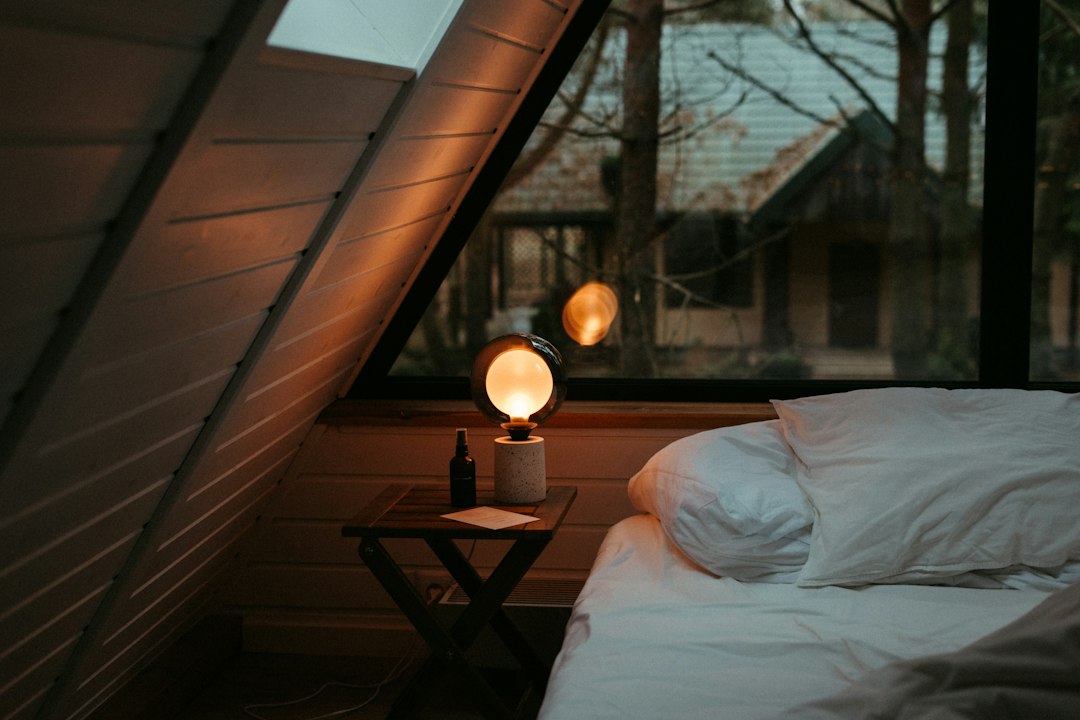
12. Keep the bedding simple and easy to adjust
Use clean sheets, comfortable pillows, and layers guests can remove or add. A light blanket plus duvet is often more flexible than one very heavy comforter. Keep an extra blanket accessible rather than buried in a storage bin elsewhere in the house.
Limit decorative pillows. Guests need somewhere to put them at night, and a tiny bedroom rarely has an extra chair or bench just for pillow storage.
13. Add a mirror where it helps someone get ready
A mirror helps guests get dressed without occupying the bathroom longer than necessary. A full-length mirror on the wall or back of the door is especially useful and takes virtually no floor space.
If there is only room for a smaller mirror, place it above the bedside surface or desk where the guest can actually stand or sit in front of it.
14. Make the guest room work as an office without looking like an office at bedtime
Many small guest rooms also serve as home offices. The key is to make the work function easy to quiet down when someone stays over. Use a desk with closed drawers or a cabinet where work supplies can disappear, route cables neatly, and leave enough desktop space for a guest to set down personal items.
A compact desk can double as a vanity or luggage surface. What does not work is a desk permanently covered with monitors, paperwork, and office equipment while the guest has nowhere else to put anything.
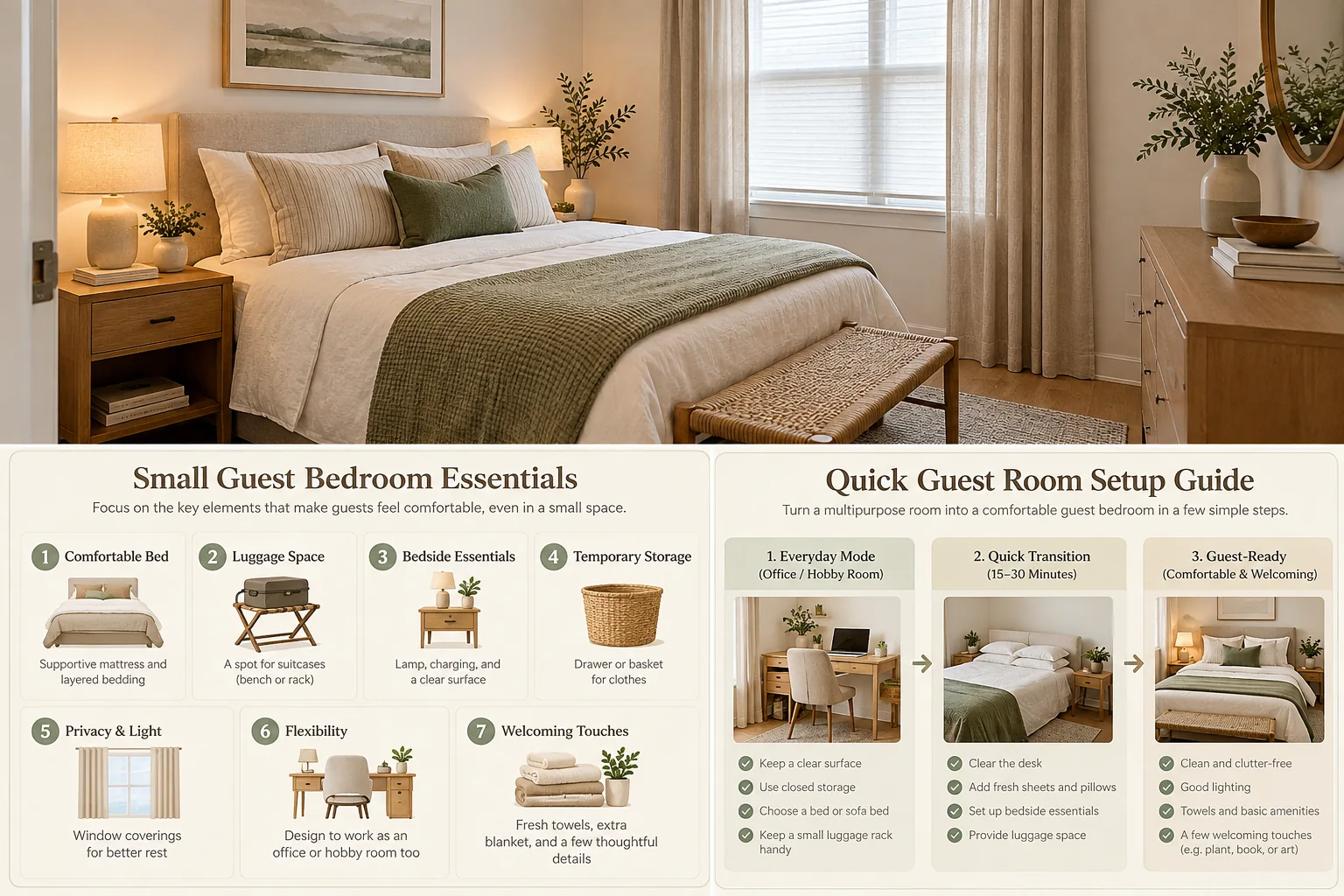
Can the room work as an office, hobby room, or storage zone when no one is staying?
Can you clear the main surfaces and floor in about 15 minutes?
Once reset, does the guest have sleep, luggage, charging, storage, light, and privacy?
15. Use decor that does not consume guest surfaces
Put most of the personality on the walls, bedding, curtains, or rug instead of covering the nightstand and dresser with objects. Art, a strong headboard, wall color, or patterned textiles can make the room feel finished while leaving usable surfaces open.
This is one place where the general principles in our small bedroom decorating guide are especially useful: visual interest should not come at the expense of breathing room.
16. Keep a small guest basket ready
A shallow basket or drawer can hold the little things guests sometimes forget: a spare toothbrush, travel-size toothpaste, tissues, earplugs, a charging cable, a lint roller, and a small flashlight. You do not need to recreate a hotel minibar.
Keep the kit small enough that it can live in the room without competing with the guest’s own belongings.
17. Leave visible empty space for the guest
The most welcoming thing in a small guest room is often something you did not put there. An empty hook, one clear shelf, a bare corner for a suitcase, an uncluttered bedside table, and a drawer with nothing in it tell the guest that the room has space for them.
If every inch is occupied by household storage and decor, the room may look styled but still feel like the guest is borrowing someone else’s storage closet.
What Furniture Is Actually Worth Having in a Small Guest Bedroom?
| Furniture | Usually worth it? | Best reason to keep it | When to skip it |
|---|---|---|---|
| Bed | Yes | Primary guest function | Only if another sleep solution is genuinely comfortable |
| Nightstand or shelf | Yes | Phone, water, glasses, charging | Skip a full table if a shelf does the job |
| Dresser | Sometimes | Longer stays or dual household storage | Short stays with closet shelf or basket available |
| Desk | Sometimes | Room doubles as office; can serve guest needs too | It blocks luggage or bed access |
| Bench | Sometimes | Luggage + seating + storage in one piece | It narrows circulation |
| Armchair | Rarely | Actually used for reading or dressing | Mostly decorative |
| Wardrobe | Sometimes | No built-in closet and frequent longer stays | Hooks and a small rail are enough |
If you are choosing new pieces rather than editing what you already own, see the best furniture for small bedrooms for a deeper buy-versus-skip framework.
Three Small Guest Bedroom Scenarios
A tiny dedicated guest room with a full-size bed
Keep the bed frame simple, add one narrow bedside surface, mount a reading light on the wall, and reserve a corner or folding rack for luggage. Use hooks rather than a chair for clothing and keep at least one shelf or drawer empty. The room does not need a dresser if most stays are only a few nights.
Prioritize: mattress, luggage space, charging, privacy. Skip first: armchair, decorative bench, oversized dresser.
A guest room that is an office most of the year
Use closed desk storage so work can disappear quickly. Give the guest one side of the closet or a row of hooks and make the desk surface clear enough to act as a landing zone. If the chair is large, make sure it can tuck fully under the desk so luggage still has a place to go.
Prioritize: 15-minute reset, cable management, clear desktop, accessible bed. Skip first: extra office storage that spills into the guest path.
A very narrow room with almost no storage
Use the walls: hooks for clothing, a floating bedside shelf, wall-mounted lighting, and a mirror on the door. Store extra bedding under the bed so the room’s limited closet or shelf space can remain available to visitors. A foldable luggage rack can be stored away when not needed.
Prioritize: vertical function and open floor. Skip first: deep dresser, large nightstand, permanent luggage bench.
A 15-Minute Guest-Room Reset Before Someone Arrives
- Strip household clutter from the nightstand, desk, dresser top, and floor.
- Make the bed with clean sheets and place an extra blanket where it is easy to find.
- Test the bedside lamp and make sure it can be switched off from bed.
- Check the outlet or charging cable and confirm it actually works.
- Clear the luggage zone completely.
- Leave several hangers, hooks, or one shelf empty.
- Empty one drawer or basket if the guest is staying more than a night or two.
- Test the window covering for privacy after dark.
- Put out water, tissues, and Wi-Fi information.
- Walk from the door to the bed and remove anything that makes the route awkward.
Common Small Guest Bedroom Mistakes
Using the room as overflow storage until the day guests arrive
If resetting the room requires moving piles of boxes to another part of the house, the storage plan is too dependent on guest-free days. Keep the core guest zones—bed, route, bedside surface, and luggage spot—easy to reclaim.
Buying a full bedroom set for occasional visitors
A bed, two nightstands, dresser, chest, and bench can overwhelm a compact room. Guest needs are lighter than full-time bedroom needs. Buy for the stay, not for the traditional furniture checklist.
Making the room beautiful but unusable
Decorative pillows on every surface, styled shelves, and fragile objects may look good in photos but leave nowhere for a guest’s phone, bag, or clothes. A guest room should make personal belongings easy to place without disturbing the decor.
Forgetting what happens after the lights go out
Nighttime details matter: can guests find the bathroom, reach water, charge a phone, close the curtains, and turn off the light from bed? Test the room after dark rather than only evaluating it during the day.
Leaving no empty storage for the guest
A fully packed closet and dresser tell the guest that their belongings belong on the floor. Even a few hangers, one drawer, and a hook create a much more comfortable stay.
Frequently Asked Questions
What should every small guest bedroom have?
At minimum, provide a comfortable sleeping surface, clean bedding, a reachable light, a place for a phone and water, easy charging, window privacy, and somewhere for luggage and a few clothes. Everything else is optional.
Does a guest bedroom need a dresser?
Not for most short stays. One empty drawer, closet shelf, basket, or hooks may be enough. A dresser makes more sense if guests stay for longer periods or the furniture also serves a useful everyday purpose.
How can I make a tiny guest room feel welcoming?
Make the practical things effortless: clean bedding, clear surfaces, accessible charging, water, towels, lighting, privacy, and visible space for belongings. Guests usually notice ease more than expensive decor.
Can a guest bedroom also be an office?
Yes. The best dual-purpose setup uses closed work storage, a desk that can double as a guest surface, cable management, and a clear reset routine so the room stops feeling like an office when someone sleeps there.
What size bed is best for a small guest room?
Choose the largest mattress that still leaves a usable route through the room and space for the guest’s basic needs. A smaller comfortable bed with good access is usually better than a larger mattress that makes the room difficult to use.
What should I put on a guest-room nightstand?
Keep it simple: a lamp or wall-light control, water, tissues, and perhaps a charging cable or small tray. Leave enough clear space for the guest’s phone, glasses, and personal items.
Bottom Line
The best small guest bedroom ideas are not about fitting a complete bedroom set into a tiny room. They are about making a short stay easy. Give guests a comfortable bed, an obvious place for luggage, a surface for essentials, easy charging, a little clothing storage, controllable light, privacy, and enough open space to move.
If the room also works as an office, hobby room, or household storage area, design those everyday functions so they can be quieted quickly. A small guest room feels generous when the guest does not have to compete with the room’s other jobs.