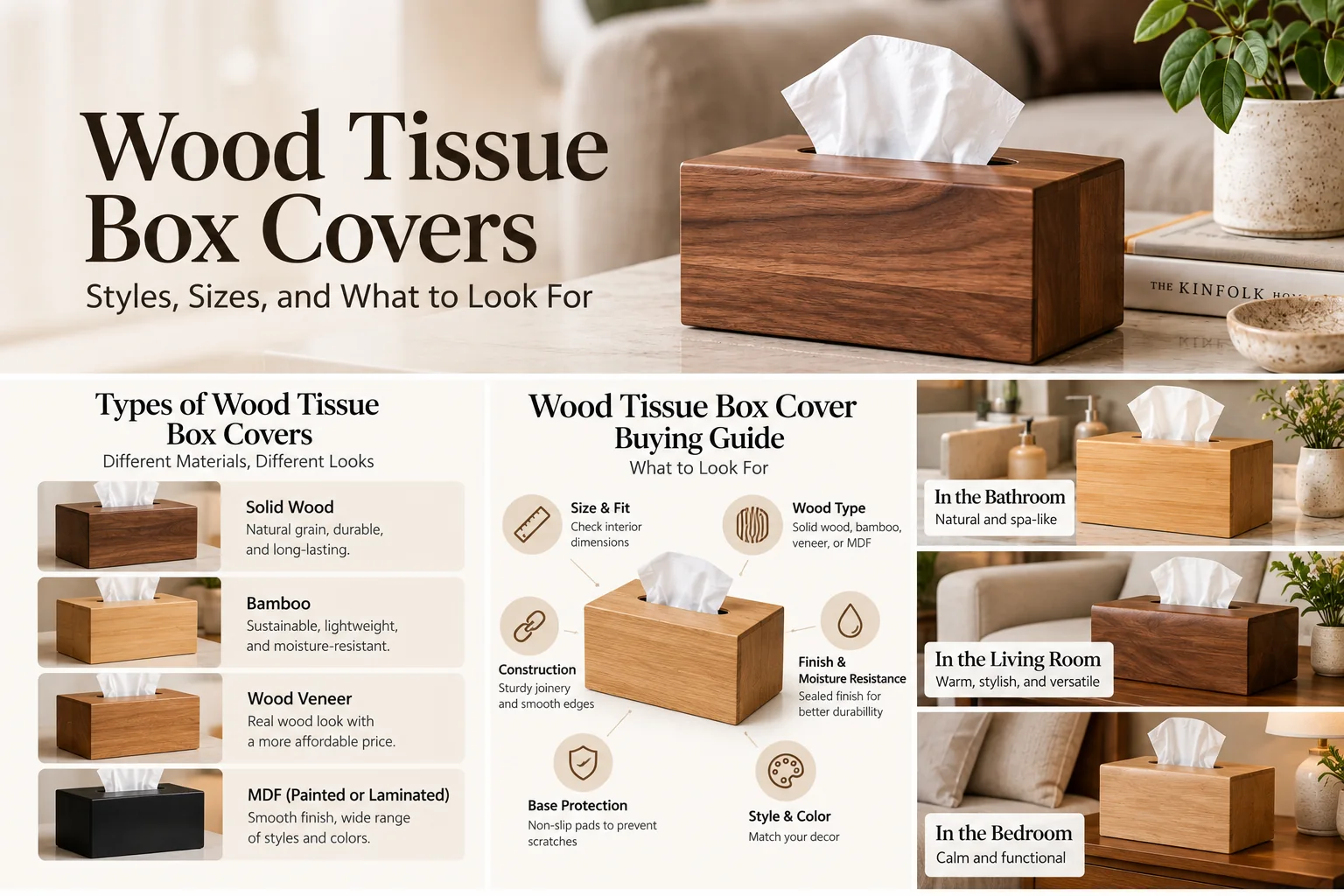

A wood tissue box cover can make an everyday box of tissues feel like part of the room instead of disposable packaging. Compared with ceramic, leather, acrylic, or fabric, wood adds warmth, visible grain, and a furniture-like quality that works especially well in living rooms, bedrooms, offices, bathrooms, and natural-style interiors.
This guide focuses specifically on wooden tissue box covers. For a broader comparison of materials and shapes, start with our complete tissue box cover guide. If you are deciding between cube and rectangular formats, see our square vs. rectangular tissue box cover guide.
What Is a Wood Tissue Box Cover?
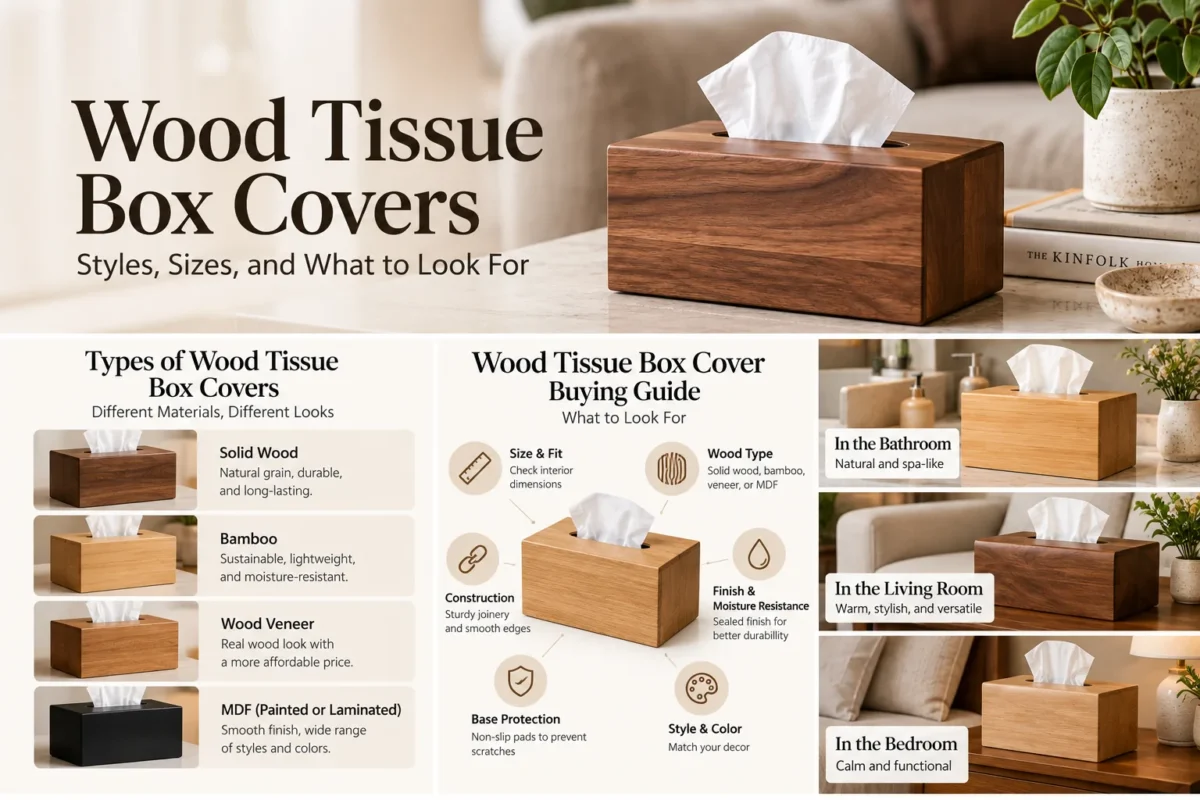
A wood tissue box cover is a rigid shell, sleeve, or lidded box designed to hide the cardboard tissue package underneath. Some covers are made from solid wood, while others use plywood, MDF, bamboo board, or engineered panels with a real-wood veneer or printed wood-look finish.
The construction affects more than price. Solid wood can show natural grain variation and age attractively, while veneered or engineered versions may stay more dimensionally stable and offer a more uniform finish. The best choice depends on the room, moisture level, budget, and the kind of visual character you want.
Solid Wood vs. Veneer, MDF, and Bamboo
| Material | Typical look | Strengths | Main concern |
|---|---|---|---|
| Solid wood | Natural grain, variation, furniture-like | Durable feel, can age well, repairable finish | Can swell, crack, or warp if poorly sealed |
| Wood veneer over MDF/plywood | Real wood surface with consistent structure | Stable, often lighter, usually less expensive | Edges can chip or delaminate if moisture gets in |
| MDF with wood-look finish | Uniform and polished | Affordable, crisp shapes, many colors | Moisture can damage exposed edges |
| Bamboo board | Light, linear grain, modern-natural | Lightweight, clean look, often moisture-tolerant when sealed | Quality and finish vary widely |
| Plywood | Modern, layered edge or veneered face | Strong for its weight, stable construction | Exposed edges may look utilitarian unless finished well |
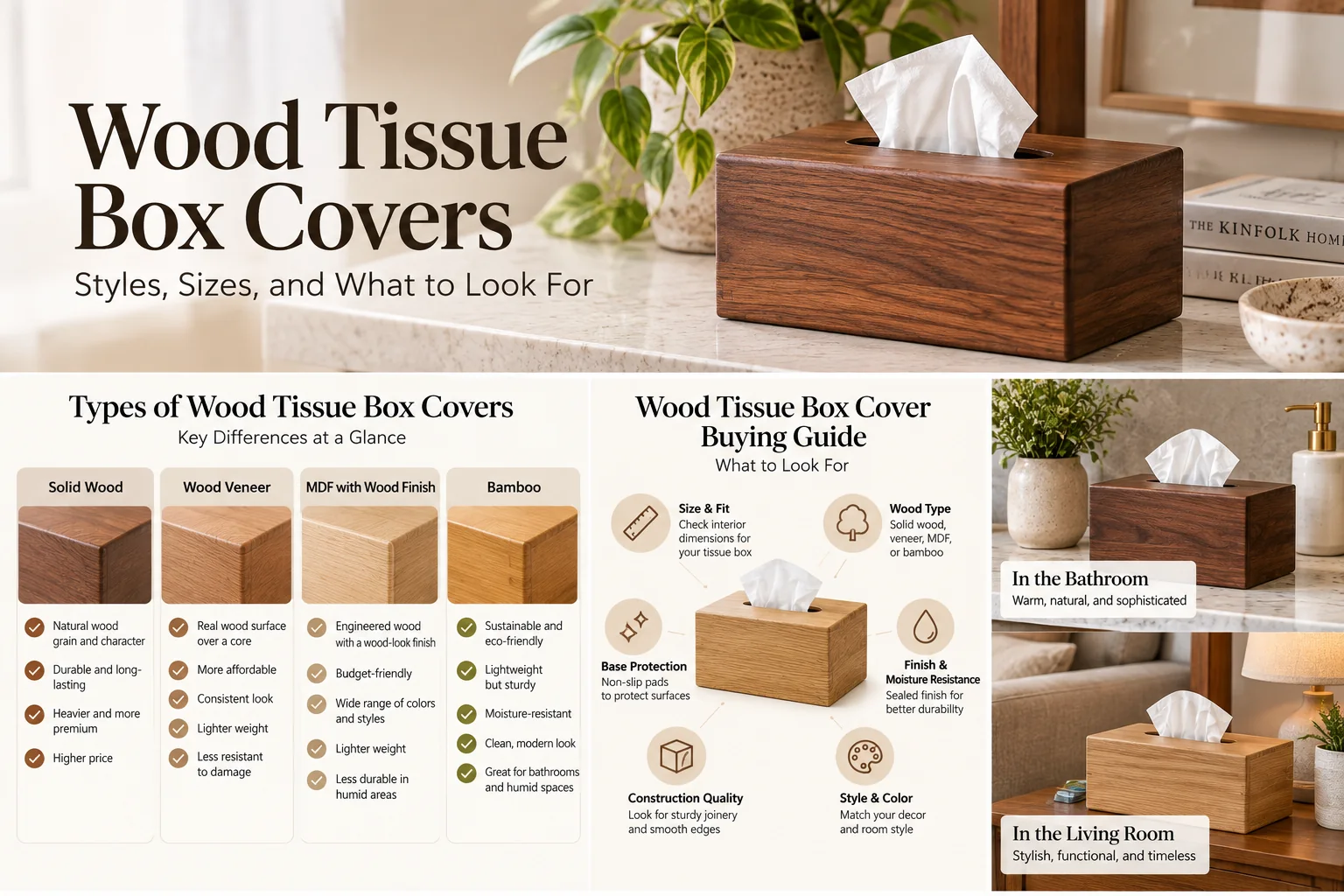
Do not assume solid wood is always better. A well-made veneered cover with sealed edges can be more practical in a bathroom than an unfinished solid-wood box. Construction quality, finish, fit, and moisture protection usually matter more than the material label by itself.
Start with dimensions and build quality. The grain and color should come last.
Pros of Wood Tissue Box Covers
1. Wood brings warmth to hard surfaces
On stone counters, glass desks, painted nightstands, and metal shelving, wood adds visual warmth without the softness of fabric. That makes it especially useful in rooms that feel too cool or flat.
2. It coordinates naturally with furniture
Oak, walnut, bamboo, ash, and dark-stained wood can echo nearby cabinetry, desks, bed frames, trays, or shelving. A tissue box cover does not need to match the furniture exactly; a related undertone is usually enough.
3. Rigid construction hides the cardboard box completely
Most wooden covers keep their shape as the tissue box empties, so they continue to look tidy. This is useful on consoles, desks, and open shelving where the tissue box remains visible all day.
4. Good finishes are easy to dust and wipe
A sealed matte, satin, lacquered, or oil-finished wood surface can usually be maintained with a soft cloth. Compared with washable fabric, there is no need to remove and launder the cover.
5. Wood works across many decor styles
Light oak fits Scandinavian and Japandi rooms, walnut suits mid-century and contemporary interiors, bamboo works in casual natural spaces, and darker woods can feel traditional or masculine. Few materials cover as many styles without looking overly decorative.
Cons to Consider Before You Buy
Moisture can damage poorly sealed wood
Water can darken unfinished wood, raise the grain, weaken MDF, or cause veneer edges to lift. If the cover will sit in a bathroom, look for sealed surfaces and finished edges rather than raw wood.
Wood can scratch delicate furniture
A hard wooden base can mark lacquer, glass, marble, or softer wood finishes. Felt pads, cork, silicone feet, or a lined underside are worth having on furniture you care about.
Rigid dimensions leave little room for error
Unlike a fabric cover, a wood box cannot stretch around a slightly oversized tissue package. Always compare your tissue box measurements with the holder’s interior dimensions.
Cheap veneer can look artificial at the edges
The face of a veneered box may look convincing while corners, openings, and underside edges reveal weak finishing. Online product photos should show close views of corners and the tissue opening, not just the front face.
What to Look For in a Wood Tissue Box Cover
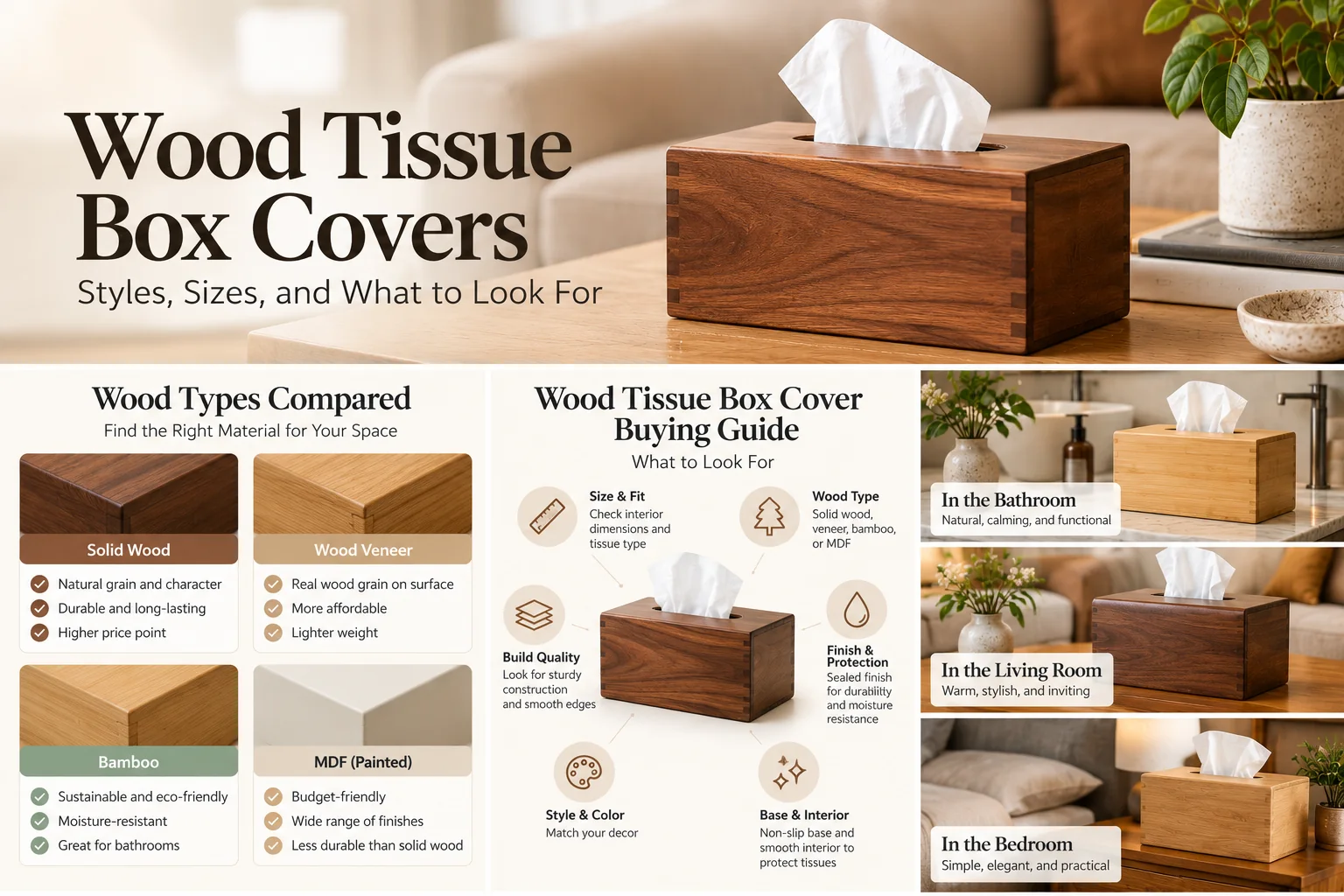
1. Measure the tissue box you actually use
Measure length, width, and height. Then compare those numbers with the cover’s interior dimensions, not just the exterior size. Leave enough clearance to slide the box in without forcing corners or scraping the sides.
2. Check the refill method
Wooden covers typically use an open bottom, removable base, sliding panel, hinged lid, or lift-off shell. Open-bottom covers are simple; sliding or magnetic bases look cleaner but should move smoothly and stay secure.
3. Inspect joinery and corners
Look for tight seams, square corners, no visible gaps, and no excess glue. Mitered joints create a clean furniture-like appearance, while box joints or visible joinery can add craft character. Poor alignment is a warning sign regardless of style.
4. Look at the finish, not just the species
Two oak covers can behave very differently if one is raw and the other is sealed. Matte lacquer, hardwax oil, polyurethane, or other protective finishes can improve stain and moisture resistance. In bathrooms, a sealed finish is more important than owning a specific wood species.
5. Check the tissue opening
The top slot should have smooth, rounded, or carefully sanded edges so tissues do not snag. A rough opening can catch paper fibers and make the box frustrating to use.
6. Protect the surface underneath
Look for felt, cork, silicone feet, or a finished base. If the cover has a raw wooden underside, add pads before placing it on a nightstand, lacquered console, or polished desk.
7. Check whether the grain is real or printed
There is nothing wrong with a wood-look finish if it is durable and well made, but the listing should be clear. Real veneer normally shows subtle variation; printed finishes tend to repeat more uniformly. Choose based on your budget and expectations rather than assuming every wood-looking cover is solid timber.
Cube vs. Rectangular Wood Tissue Box Covers
| Shape | Advantages | Watch for | Best locations |
|---|---|---|---|
| Cube | Compact footprint, decorative, easy to center on a surface | Taller profile can feel bulky on shallow shelves | Bathrooms, nightstands, desks |
| Rectangular | Lower profile, familiar tissue format, often larger capacity | Takes more horizontal space | Consoles, offices, living rooms, larger counters |
If you are unsure which format suits your space, our square vs. rectangular tissue box cover comparison goes deeper into dimensions, footprint, capacity, and room placement.
Popular Wood Styles and Finishes
| Wood / finish | Visual effect | Works well with |
|---|---|---|
| Light oak | Airy, calm, natural | Scandinavian, Japandi, coastal, minimalist |
| Walnut | Rich, warm, refined | Mid-century, contemporary, office interiors |
| Bamboo | Fresh, casual, linear grain | Natural, spa-like, relaxed bathrooms |
| Ash or maple | Pale, clean, subtle grain | Modern, light-toned bedrooms and offices |
| Dark stained wood | Formal, grounded, dramatic | Traditional rooms, dark furniture, masculine offices |
| Black painted wood | Graphic and minimal | Modern bathrooms, monochrome interiors |
| Whitewashed wood | Soft, casual, coastal | Cottage, beach, relaxed guest rooms |
Best Places to Use Wood Tissue Box Covers
Living room console or side table
Wood is especially easy to style beside books, trays, lamps, ceramics, and natural textiles. A walnut or oak cover can act like a small furniture accessory rather than a utility item. For more placement ideas, see our guide to styling tissue boxes in every room.
Bedroom nightstand
A compact cube in oak, ash, walnut, or bamboo can coordinate with a bed frame or bedside table without adding visual clutter. Make sure the base is protected if your nightstand has a painted or lacquered finish.
Home office
Wood pairs naturally with desk organizers, monitor stands, trays, and stationery. Rectangular covers often work well on deeper desks, while cubes save horizontal space on smaller work surfaces.
Bathroom vanity
Use sealed wood, bamboo, or a moisture-resistant veneered construction rather than raw MDF or unfinished timber. Keep the cover away from standing water and wipe splashes quickly. If your vanity gets wet frequently, a ceramic or porcelain tissue box cover may be easier to maintain.
Guest room
Wood gives a guest room a finished, permanent feel and works with changing bedding more easily than highly patterned decor. Light oak and walnut are especially versatile.
Where Wood Is Probably Not the Best Choice
- Very wet bathrooms: repeated direct water exposure can damage joints, MDF cores, or veneer edges.
- Children’s rooms: a lighter washable cover may be easier if the box is frequently dropped.
- Outdoor spaces: humidity, sun, and temperature swings are hard on indoor wood finishes.
- Very narrow shelves: heavier wood covers are less forgiving if knocked from a height.
- Homes that change tissue box sizes often: rigid wood covers require consistent dimensions.
How to Clean a Wood Tissue Box Cover
- Remove the tissue box before cleaning.
- Dust with a soft dry or slightly damp microfiber cloth.
- Wipe spills quickly instead of letting water sit on the finish.
- Use only mild cleaner if the manufacturer says the finish can handle it.
- Avoid soaking, abrasive sponges, bleach, and harsh solvents.
- Dry the base and edges before replacing the cardboard tissue box.
Unfinished, oiled, waxed, painted, lacquered, and veneered wood all need slightly different care. Follow the maker’s instructions rather than treating every wooden cover the same.
60-Second Wood Tissue Box Cover Buying Checklist
- Measure your usual tissue box and compare it with the cover’s interior dimensions.
- Confirm the construction — solid wood, veneer, bamboo, plywood, or MDF.
- Check the refill method — open bottom, sliding base, hinged lid, or lift-off shell.
- Inspect joinery and edges for gaps, roughness, lifting veneer, or visible glue.
- Check the finish for moisture and stain resistance appropriate to the room.
- Inspect the tissue opening for smooth, snag-free edges.
- Check the underside for felt, cork, silicone, or another furniture-safe base.
- Match the undertone to nearby furniture instead of trying to match the exact wood species.
Light oak + simple cube + matte sealed finish.
Walnut + rectangular form + felt-lined base.
Sealed bamboo or veneer + protected edges + compact footprint.
Common Buying Mistakes
Buying by exterior dimensions
Wood walls can be thick, especially on handmade or solid-wood covers. Exterior dimensions do not tell you whether your tissue box will fit inside.
Assuming “wood” means solid wood
Many attractive covers use veneer, bamboo board, plywood, or MDF. That is not necessarily a problem, but the construction should match your expectations and moisture conditions.
Ignoring the bottom edge
The underside is easy to overlook in product photos. Raw wood can scratch furniture, while exposed MDF or veneer seams are vulnerable to moisture.
Matching wood too literally
A tissue box cover does not need to be the same species as your furniture. Focus on undertone — warm, cool, reddish, golden, or neutral — so the pieces coordinate without looking like a matched set.
Frequently Asked Questions
Is solid wood better than MDF for a tissue box cover?
Not always. Solid wood offers natural grain and can age well, while MDF can create crisp, stable shapes at a lower cost. In damp rooms, finish quality and sealed edges matter more than the label alone.
Can I use a wood tissue box cover in a bathroom?
Yes, if the cover is properly sealed and kept away from standing water. Bamboo, sealed veneer, and lacquered wood can work well on a reasonably dry vanity. Raw MDF and unfinished wood are poor choices for repeated splashes.
Do wooden tissue box covers fit all brands?
No. Rigid covers are normally designed around a specific cube or rectangular box size. Measure the tissue package you buy most often and compare it with the holder’s interior dimensions.
What wood color is easiest to decorate with?
Light oak, walnut, bamboo, medium natural brown, and black are among the easiest to coordinate. Light oak feels airy, walnut adds richness, bamboo feels casual and natural, and black works well in modern rooms.
How do I stop a wood tissue box cover from scratching furniture?
Choose a cover with felt, cork, or silicone on the underside, or add small clear furniture pads yourself before using it on delicate surfaces.
A 3-Step Fit Check Before You Order
- Measure the tissue box you actually buy. Note length, width, and height.
- Compare those numbers with the cover’s interior dimensions. Leave a little clearance so the package slides in without forcing the joints.
- Check the refill path. Make sure the base, lid, or shell can be opened easily where the cover will actually sit.
If a listing gives only exterior dimensions, ask for internal measurements before ordering. That one step prevents most fit problems with rigid wooden covers.
Bottom Line
A wood tissue box cover is a strong choice when you want a warm, furniture-like accessory that hides packaging without looking fussy. The best options combine accurate interior dimensions, sound joinery, smooth edges, a room-appropriate finish, easy refill access, and a protected underside.
Start with fit and construction, then choose the wood tone. Light oak, walnut, bamboo, dark-stained wood, and painted finishes can all work well when the practical details are right.